

15 Aug Structural Ageing of the Face and Neck: How Anatomy Changes Over Time
Ageing of the face and neck is a gradual and individual process influenced by anatomy, genetics, environmental exposure and time. While many visible changes appear at skin level, structural ageing of the face and neck also involves changes in fat, retaining ligaments, muscle, bone and deeper supporting tissues.
As a Specialist Plastic and Reconstructive Surgeon based in Perth, Western Australia, Dr Guy Watts frequently consults with patients seeking a clear explanation of how ageing affects the face and neck. For many, the goal is understanding rather than change. This article explains the anatomical processes involved in facial and neck ageing and outlines how surgery may address specific structural changes as part of a carefully planned and individualised approach.
Understanding Facial Ageing As A Structural Process
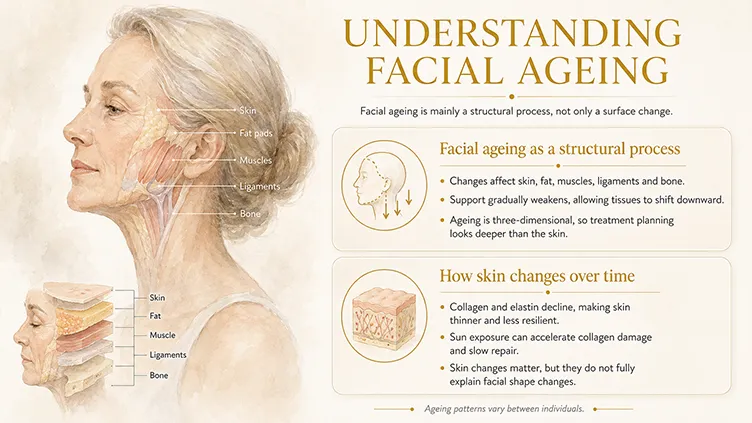
Facial ageing is often perceived as a surface issue, but it is primarily structural. Over time, changes occur across several anatomical layers, including the skin, fat compartments, muscles, ligaments, and underlying bone. Each layer contributes differently, and the timing and degree of change vary significantly between individuals. These changes are explored in more detail in our guide to how each anatomical layer of the face changes with ageing.
In early adulthood, facial tissues are typically well supported, with stable ligamentous attachments and balanced volume distribution. As ageing progresses, these support structures gradually change, allowing tissues to shift under the influence of gravity. These changes occur slowly and may not be immediately noticeable.
Understanding ageing as a three-dimensional process helps patients appreciate why surgical planning focuses on deeper anatomy rather than surface appearance alone.
How Skin Changes Over Time
The skin changes continuously throughout life. With increasing age, collagen production slows and existing collagen fibres become fragmented. Elastin fibres, which allow the skin to stretch and return to its resting position, also degrade over time. As a result, the skin gradually becomes thinner and less resilient.
In Australia, cumulative sun exposure plays a significant role in how skin changes over time. Ultraviolet radiation affects collagen structure and the skin’s ability to repair itself. Even when sun protection is adopted later in life, earlier exposure continues to influence skin characteristics.
Although changes in skin texture and firmness are often the most noticeable signs of ageing, they do not fully explain broader changes in facial shape or balance.
Changes In Facial Fat And Volume Distribution
Facial fat is organised into distinct compartments, each with its own pattern of change over time. The different behaviour of these compartments is discussed further in how facial fat compartments change with ageing. Rather than disappearing evenly, fat volume redistributes. Some compartments gradually lose volume, while others shift position due to changes in support.
Alterations in midface volume can influence cheek projection and the appearance of folds between the nose and mouth. Changes in the lower face may affect how tissue sits along the jawline.
These shifts explain why surgical approaches often focus on repositioning deeper tissue layers rather than addressing skin alone.
Ligaments And Muscular Support With Age
Ligaments play an essential role in supporting facial tissues by anchoring them to deeper structures. Over time, these retaining ligaments gradually lengthen and change, allowing increased tissue movement.
Facial muscles continue to function throughout life, and repeated movement over decades can influence resting posture. Changes in muscle tone may affect how tissues sit when the face is at rest.
Anatomy-guided surgical approaches aim to address these support systems as part of managing structural changes associated with ageing.
The Role Of Bone Structure In Facial Ageing
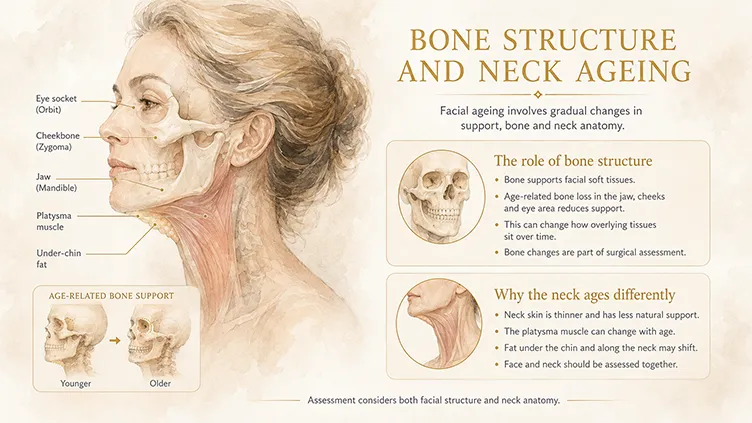
Bone provides the framework that supports facial soft tissues. With age, gradual bone resorption occurs in areas such as the jaw, cheekbones, and eye sockets. These changes reduce skeletal support and alter the foundation beneath the soft tissues.
As bone support changes, overlying tissues may appear differently positioned. Although these skeletal changes occur slowly, they are an important consideration in long-term facial ageing.
Recognition of bone structure changes forms part of a comprehensive surgical assessment.
Why The Neck Ages Differently To The Face
The neck has distinct anatomical features that influence how it changes over time. The skin of the neck is thinner and contains fewer oil glands than facial skin, affecting elasticity. Structural support is also more limited.
The platysma muscle plays a key role in neck appearance. With age, this muscle may alter in position or function. Changes in fat distribution beneath the chin and along the neck can also occur.
Because the face and neck are anatomically connected, assessment of both areas together is essential when considering surgery.
When Non Surgical Measures May No Longer Address Structural Changes
Non surgical approaches may assist with managing early skin-related changes. However, they do not alter ligament position, tissue support, or deeper anatomical relationships.
As structural changes progress, some individuals find that non surgical options no longer address the changes they are noticing. At this stage, a surgical consultation may help clarify whether surgery could address specific anatomical factors.
Clear discussion of potential benefits and limitations is essential for informed decision-making.
What A Facelift Addresses From An Anatomical Perspective
A facelift is a surgical procedure designed to address structural changes affecting the lower face and neck. Contemporary techniques focus on adjusting deeper tissue layers to support facial balance and proportions.
Rather than relying on skin tension, anatomy-guided approaches involve modifying underlying structures in a way that aligns with natural anatomy. This reduces reliance on surface skin adjustment alone.
The surgical plan is tailored to individual anatomy and degree of structural change.
Anatomy Guided Facelift Techniques Explained
Anatomy-guided facelift techniques are based on detailed knowledge of facial structure and ageing patterns. These approaches involve careful modification of deeper tissues that have shifted over time.
By addressing the layers most affected by ageing, surgical planning focuses on supporting balance rather than applying uniform changes. This approach recognises individual variation and avoids standardised solutions.
Careful assessment and planning are central to this process. Depending on the anatomical findings, surgical planning may include approaches such as a SMAS facelift or deep-plane facelift, with technique selection based on the structures being addressed.
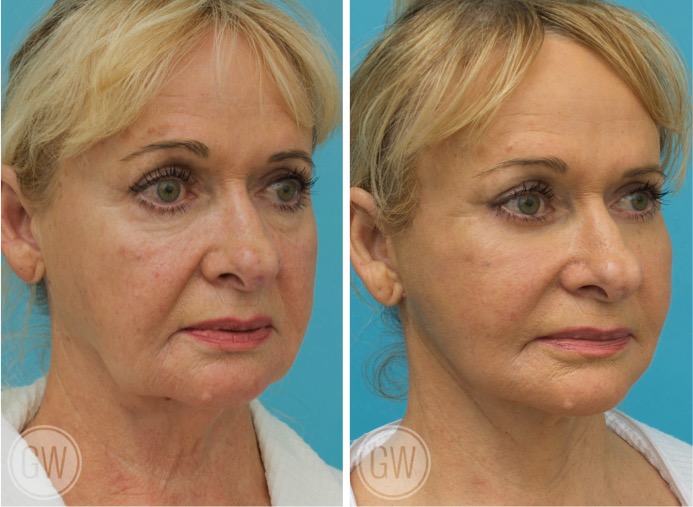
Face and Neck Surgery Before and After Photos

Photo disclaimer:
Each surgical procedure produces unique outcomes influenced by factors such as body composition, skin tone, laxity, age, and genetics. The before-and-after photographs displayed are of actual patients and are provided for informational purposes only.
Considering Age Versus Anatomical Change
Chronological age alone does not determine whether surgery may be appropriate. Some individuals experience structural changes earlier, while others maintain stable support later in life. The same principle applies when considering facelift surgery in the 40s, 50s and 60s, where planning is based on individual anatomy and clinical findings rather than chronological age alone.
Assessment focuses on anatomy, skin characteristics, tissue position, and overall health. This allows decisions to be guided by physical findings rather than age-based assumptions.
This approach supports ethical, patient-centred care.
Emotional And Psychological Considerations
Changes in facial appearance can prompt reflection and questions about ageing over time. Many patients seek clarity and understanding rather than a specific outcome.
A thorough consultation explores motivations and expectations carefully. Surgery is considered only when goals are realistic and well understood.
Clear communication supports informed consent and appropriate decision-making.
The Importance Of Personalised Surgical Planning
Every face is different, and surgical planning reflects this. Personalised assessment includes physical examination, photographic analysis, and detailed discussion.
Patients are encouraged to take time to understand proposed procedures, recovery expectations, and potential risks. This process supports clarity before any decision is made.
Individualised planning is central to responsible surgical care.
Take our quiz, and find out if you are ready for surgery
Recovery And Healing Considerations
Recovery following facial surgery varies between individuals. Factors such as the extent of surgery, general health, and adherence to postoperative guidance influence healing.
Patients receive detailed instructions to support recovery as anticipated. Ongoing follow-up allows progress to be monitored and any concerns addressed.
Understanding recovery expectations helps patients plan appropriately.
Local Considerations For Patients In Perth
For patients in Perth and across Western Australia, access to local care is an important consideration. Being treated locally allows consistent follow-up and continuity of care.
This accessibility supports appropriate monitoring throughout the healing process.

FAQs About How Ageing Affects The Face And Neck And When Surgery Can Help
Making An Informed Decision About Surgery
Deciding whether to proceed with surgery is a personal process that requires careful consideration. Patients are encouraged to reflect on their motivations, expectations, and readiness.
A consultation with a Specialist Plastic and Reconstructive Surgeon provides an opportunity for education and discussion.
A Thoughtful Approach To Facial And Neck Ageing
Facial and neck ageing are natural processes influenced by anatomy, environment, and time. Surgery may assist some individuals in addressing specific structural changes, but it is not appropriate for everyone.
Understanding how ageing affects the face and neck allows patients to approach decisions with clarity and realistic expectations. An anatomy-guided and patient-centred approach supports careful planning and responsible care.
DOWNLOAD DR GUY WATTS’ FACE AND NECK LIFT SURGERY GUIDE
Further Reading
- Read Dr Guy Watts’ Procedure Page on Deep Plane Facelift
- Read Dr Guy Watts’ Procedure Page on Deep Neck Lift Surgery Perth
- Read Dr Guy Watts’ Procedure Page on SMAS Facelift
- Read Dr Guy Watts’ Blog about Facelift Longevity: How Long Results Last and What Influences Them
- Read Dr Guy Watts’ Blog about Can a Face Lift Look Natural? Understanding Today’s Techniques for Facial Balance
- Read Dr Guy Watts’ Blog about Combining Face Lift With Eyelid and Brow Procedures
About Dr. Guy Watts – MED0001539378
FRACS (Plas) – Specialist Plastic Surgeon In Perth WA

Dr. Guy Watts is a Specialist Plastic Surgeon (AHPRA MED0001539378) with an extensive career that spans across renowned plastic surgery clinics worldwide. His experience has been honed through invaluable experiences at esteemed establishments such as the New York Eye and Ear Infirmary and the renowned Pitanguy Clinic in Brazil.
Having collaborated with the foremost cosmetic plastic surgeons on a global scale, Dr. Watts has chosen to return to Perth after a 17-year journey of intensive training and invaluable professional experience to bring the latest practices and technology in cosmetic plastic surgery to his patients.
Dr. Watts is a Fellow of the Royal Australasian College of Surgeons (FRACS) and a Member of the Australian Society of Plastic Surgeons (ASPS), Australasian Society of Aesthetic Plastic Surgeons (ASAPS) and the International Society of Aesthetic Plastic Surgeons (ISAPS).
Read about the potential Risks and Complications of Surgery
Read the Patient Information and Resources
About CLINISPA
Clinispa is Dr Watts’ bespoke medical clinic performing Cosmetic Aesthetic treatments. At Clinispa, we offer advanced clinical treatments in a luxurious and calming environment, tailored to support your skin’s health and appearance.
Clinispa aesthetic services are performed by Dr Guy Watts’ nursing professionals, who have a passion for and solid understanding of facial aesthetics.
All Clinispa clients are considered individually, with a personalised treatment plan consisting of advanced scientific approaches to cosmetic aesthetics. We incorporate innovative technologies in conjunction with superiorly formulated skin care.
For more information about the full range of Clinispa Aesthetic of Cosmetic Treatments visit the Clinispa website
Sorry, the comment form is closed at this time.