


20 Apr Facelift and Neck Lift in Perth: When Combined Surgery May Be Considered
As people move through different stages of life, structural and tissue-related changes often occur across the face and neck. For some, these changes are gradual, while for others they may seem more pronounced over a shorter period. These changes may include soft tissue descent, reduced skin elasticity, or visible alterations in the jawline and upper neck.
Some individuals begin to consider surgical options when these developments affect how they view their appearance or when non-surgical treatments no longer align with their goals. One question that often arises is whether a facelift alone is suitable, or whether a combined facelift and neck lift is more appropriate.
In Perth, Dr Guy Watts, Specialist Plastic & Reconstructive Surgeon, provides detailed and thoughtful guidance to individuals exploring surgical options. Each consultation is conducted with the aim of understanding personal goals, assessing anatomical factors, and establishing whether a combined surgical plan may support a more cohesive outcome.
Take our quiz, and find out if you are ready for surgery
What A Facelift Involves
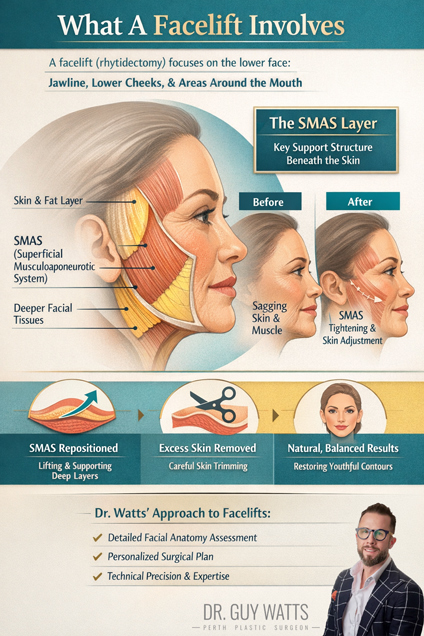
A facelift, or rhytidectomy, is a facial surgical procedure focused on the lower two-thirds of the face. This includes the jawline, lower cheeks, and tissues adjacent to the mouth. Contrary to the perception that a facelift only involves tightening the skin, modern techniques aim to adjust the deeper structural layers of the face.
One of the key components in facelift surgery is the SMAS, or superficial musculoaponeurotic system. This tissue layer, which lies beneath the skin and fat, contributes significantly to facial shape and support. Over time, this layer may shift due to factors such as gravity, loss of collagen, and changes in surrounding tissues.
During surgery, the SMAS is repositioned rather than removed. This adjustment helps support the overlying skin and soft tissue in a way that reflects the individual’s natural facial structure. In some cases, excess skin is also carefully removed, but always with the aim of avoiding tension and promoting a balanced result.
Dr Watts performs each facelift based on a comprehensive understanding of facial anatomy. He considers the thickness of the skin, tissue elasticity, bone structure, and the individual’s history of previous procedures or treatments. The emphasis remains on technical precision and anatomical accuracy. For patients interested in the role of facial anatomy and nerve preservation during advanced facelift techniques, read more about deep-plane facelift safety and surgical planning.
What A Neck Lift Targets
A neck lift addresses structural and soft tissue changes beneath the jaw and along the front and sides of the neck. This area can be affected by visible muscle activity, reduction in soft tissue support, and accumulation of skin that no longer sits as it once did.
The platysma muscle is often involved in these changes. Over time, this paired muscle can begin to separate along the midline, creating visible bands or loss of neck definition. During a neck lift, Dr Watts may tighten and reposition the platysma centrally (under the chin), laterally (along the sides), or both.
In addition to muscle adjustment, excess or inelastic skin may be removed, and in some cases, soft tissue volume under the chin is carefully addressed. The goal is not to reshape the neck into something entirely different, but to support the existing anatomy in a way that aligns more closely with the individual’s preferences.
Incisions are typically placed behind the ears and, when needed, under the chin. These are designed to be discreet while allowing appropriate surgical access. Scar care is an ongoing part of the healing process, and Dr Watts provides education and follow-up to support this aspect of recovery.
DOWNLOAD DR GUY WATTS’ FACE AND NECK LIFT SURGERY GUIDE
Why Some Individuals Consider Combining The Two Procedures
The face and neck are functionally and visually connected. Anatomically, the platysma muscle, lower facial fat pads, SMAS layer, and overlying skin all transition from the face into the neck without interruption. This connection means that changes in one area often affect how the other appears.
When a facelift is performed without a neck lift, the result may leave the neck untreated, creating a visual mismatch. Likewise, performing a neck lift alone may not address adjacent tissues along the jaw or lower cheeks that have also changed over time.
By combining the two procedures, Dr Watts is able to work across these connected zones in a coordinated manner. This approach supports proportion across the face and neck, allowing for changes that are measured and aligned.
Other potential benefits of a combined approach include:
- A single recovery period, rather than two separate ones
- A more efficient surgical sequence
- An opportunity to work through shared incision sites to address both areas
Importantly, combining procedures is not about increasing the scale of surgery. It is about working responsibly within the same anatomical region to address related features where clinically indicated.
Facial Balance And The Jaw-Neck Transition
One of the most important considerations in facial surgery is balance. The transition from jawline to neck is particularly sensitive to changes in soft tissue structure. When the cervicomental angle becomes less defined, or when soft tissues beneath the jaw change position, the overall perception of facial shape can shift.
Some individuals begin to notice that the way their lower face and neck appear no longer reflects how they feel or how they looked in the past. While ageing is a natural process, not everyone experiences the same pattern or timeline of structural changes.
In Dr Watts’ clinical practice, photographic analysis and anatomical assessment help clarify how the face and neck relate to one another. This guides surgical planning and helps determine whether a combined approach is supported by the individual’s anatomy.
Who Might Be Suitable For Combined Surgery
Dr Watts sees a wide age range of patients considering facial surgery, but most individuals who explore a combined facelift and neck lift fall between their mid-40s and late 60s. Suitability, however, is based less on age and more on the following:
- Skin elasticity
- Muscle tone and position
- Degree of soft tissue changes
- Bone structure and chin–neck angle
- Overall health and recovery capacity
Individuals who smoke are advised to stop well in advance of surgery due to the significant effect smoking can have on wound healing. A thorough medical history is also required to assess factors such as medications, blood pressure, and circulation.
Dr Watts encourages patients in Perth and surrounding areas to attend consultation with clear questions and an open mindset. Each surgical decision is made based on anatomy, safety, and informed expectations, not cosmetic trends.
When Is The Right Time To Consider Facelift And Neck Lift Combined Surgery?
There is no fixed timeline for when someone should explore a combined face and neck procedure. For many individuals, interest develops gradually after trying other options. Some may notice changes in how clothing fits around the neck, how light falls on the lower face in photographs, or how their profile has altered over time.
Timing often becomes a discussion when:
- Non-surgical treatments no longer support personal goals
- The jaw–neck transition appears different to earlier stages of life
- Both regions are being considered for surgery at separate times
- The individual has sufficient time available for recovery
Dr Watts helps patients weigh the advantages of a combined approach versus staged procedures. His recommendation is always grounded in clinical observation, not preference for any particular method.
Face and Neck Lift Surgery Before and After Photos
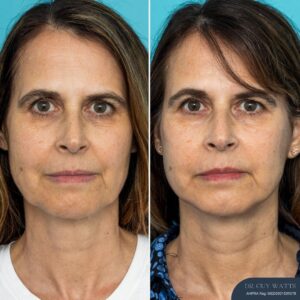
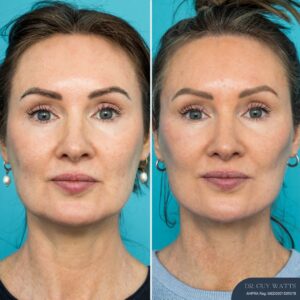
Photo disclaimer:
Each surgical procedure produces unique outcomes influenced by factors such as body composition, skin tone, laxity, age, and genetics. The before-and-after photographs displayed are of actual patients and are provided for informational purposes only.
How The Surgery Is Performed
Facelift and neck lift procedures are typically performed in a hospital or day surgery facility under general anaesthesia. Dr Watts operates alongside an experienced perioperative team with anaesthetists, nurses and surgical assistants.
Incisions are planned around the ears and hairline, with optional placement beneath the chin. These allow access to the SMAS layer, platysma muscle, and relevant soft tissue structures. The surgery is conducted with a focus on structural adjustment rather than surface-level change.
Once the deeper tissues have been repositioned, the overlying skin is re-draped without tension. This helps maintain skin health and allows incisions to be closed with precision. The entire process is structured to support recovery and reduce strain on healing tissues.
Recovery And Post-Operative Support
After surgery, most patients spend a short period in recovery before returning home on the same day or the following morning. Swelling and bruising are expected and tend to reach their peak within the first week before gradually settling.
A light dressing may be applied, and in some cases, a supportive garment is used to help maintain position. Patients are given detailed instructions, including:
- How to care for incisions
- When to attend follow-up appointments
- How to sleep comfortably during early recovery
- What activities to avoid during the first few weeks
Dr Watts and his team provide structured follow-up care in Perth, with multiple review points to assess healing. Patients can also reach out between appointments with questions or concerns.
Recovery progresses differently for each individual. Some return to light duties within two weeks, while others prefer to take additional time depending on lifestyle and work commitments. Full recovery can continue over several months as swelling subsides and tissues stabilise.
Facelift And Neck Lift Combined Surgery: Understanding Risks
Dr Watts is committed to informed, transparent care. As with all surgical procedures, a combined facelift and neck lift carries potential risks. These include:
- Bleeding or fluid collection
- Infection
- Delayed healing or changes in sensation
- Scar irregularities
- Temporary or persistent asymmetry
Every effort is made to support healing and reduce complications, from pre-operative screening to surgical technique and aftercare. Risks are discussed clearly during consultation and patients receive written information to review at home.

FAQs About Combined Face Lift And Neck Lift Surgery
Dr Watts’ Approach To Combined Facial Surgery
Dr Guy Watts brings specialist training and focused experience in facial procedures. His practice in Perth centres on providing ethical, patient-focused care that supports anatomical understanding and responsible decision-making.
His consultations are collaborative and thorough. He works closely with each person to understand what matters to them, how their anatomy is evolving, and what changes may or may not be appropriate. There is no pressure to pursue surgery, and no claims made about guaranteed results.
From consultation to surgery and post-operative care, Dr Watts offers a consistent and medically grounded experience. Each recommendation is made in the interest of safety, proportion, and patient understanding.
Further Reading
- Read more about Deep Plane Facelift
- Read Dr Watts’ Blogs on Anterior Neck-Lift Surgery: When It’s Considered And Why
- Read Dr Watts’ Blogs on Recovery After Neck Lift Surgery
- Read Dr Watts’ Blogs on A Surgeon’s Guide To Facial Ligaments: Why They Matter In Facelifts
- Read Dr Watts’ Blogs on Can A Face Lift Look Natural? Understanding Today’s Techniques For Facial Balance
About Dr. Guy Watts – MED0001539378
FRACS (Plas) – Specialist Plastic Surgeon In Perth WA

Dr. Guy Watts is a Specialist Plastic Surgeon (AHPRA MED0001539378) with an extensive career that spans across renowned plastic surgery clinics worldwide. His experience has been honed through invaluable experiences at esteemed establishments such as the New York Eye and Ear Infirmary and the renowned Pitanguy Clinic in Brazil.
Having collaborated with the foremost cosmetic plastic surgeons on a global scale, Dr. Watts has chosen to return to Perth after a 17-year journey of intensive training and invaluable professional experience to bring the latest practices and technology in cosmetic plastic surgery to his patients.
Dr. Watts is a Fellow of the Royal Australasian College of Surgeons (FRACS) and a Member of the Australian Society of Plastic Surgeons (ASPS), Australasian Society of Aesthetic Plastic Surgeons (ASAPS) and the International Society of Aesthetic Plastic Surgeons (ISAPS).
Read about the potential Risks and Complications of Surgery
Read the Patient Information and Resources
About CLINISPA
Clinispa is Dr Watts’ bespoke medical clinic performing Cosmetic Aesthetic treatments. At Clinispa, we offer advanced clinical treatments in a luxurious and calming environment, tailored to support your skin’s health and appearance.
Clinispa aesthetic services are performed by Dr Guy Watts’ nursing professionals, who have a passion for and solid understanding of facial aesthetics.
All Clinispa clients are considered individually, with a personalised treatment plan consisting of advanced scientific approaches to cosmetic aesthetics. We incorporate innovative technologies in conjunction with superiorly formulated skin care.
For more information about the full range of Clinispa Aesthetic of Cosmetic Treatments visit the Clinispa website
Sorry, the comment form is closed at this time.