

02 May Deep-Plane Face Lift Safety: Nerve Protection And Surgical Planning
Surgical procedures involving the face require precision, anatomical understanding, and thorough planning. The face is not only a visual focal point but also a complex structure responsible for communication, movement and emotion. For individuals in Perth considering facial surgery, particularly the deep-plane face lift, it is important to understand how safety is promoted throughout the surgical process.
The deep-plane face lift is a technique that focuses on adjusting the deeper structural layers of the face. Rather than changing the surface alone, it works beneath the skin to reposition supportive tissues. This method brings the surgeon into close proximity with key nerves, which makes detailed anatomical planning essential. Dr Guy Watts, Specialist Plastic & Reconstructive Surgeon in Perth, performs deep-plane face lift procedures with an emphasis on nerve awareness, surgical accuracy and personalised care.
This article outlines what the deep-plane face lift involves, how nerve protection is supported, and the importance of planning and preparation when considering this type of surgery.
Take our quiz, and find out if you are ready for surgery
What Is A Deep-Plane Face Lift?
A deep-plane face lift is a procedure designed to address underlying tissue changes that may occur with time. It differs from surface-level procedures by working beneath the skin and the superficial musculoaponeurotic system (SMAS). This layer supports the cheeks, lower face and jawline.
Rather than adjusting only the outer layers, this technique involves releasing and repositioning deeper tissues that play a role in how the face is structured. It aims to support a more natural alignment between the skin and the underlying framework. Because this approach requires the surgeon to work at a deeper level, it involves careful dissection near the facial nerve branches.
This level of access allows the face to be adjusted without relying on surface tension. However, it also brings a higher level of responsibility and the need for precision in protecting nerve function.
Why Safety Plays A Central Role In Deep-Plane Surgery
Surgery at any depth involves risk, but procedures that involve the face require additional care due to the presence of vital structures. In a deep-plane face lift, the surgeon works beneath the SMAS layer and around retaining ligaments that support facial soft tissues. This is where several branches of the facial nerve are located.
Dr Guy Watts takes a methodical approach to promote safety and reduce the likelihood of nerve irritation. This includes patient selection, comprehensive assessment, clear communication and intraoperative strategies that are aligned with known anatomical pathways. While temporary nerve effects can occur in some cases, the risk of long-term nerve issues is considered low when the procedure is carried out with appropriate care.
Preoperative planning helps identify whether a deep-plane approach is suited to the individual’s anatomy, goals and medical background. In some cases, variations in nerve position or a history of previous surgery may influence the plan.
DOWNLOAD DR GUY WATTS’ FACE AND NECK LIFT SURGERY GUIDE
Understanding Facial Nerve Branches And Their Protection
The facial nerve is responsible for voluntary facial movement. After exiting the skull, it branches into several smaller nerves that control specific functions such as eyebrow elevation, smiling and lip control. The most relevant branches during a deep-plane face lift include:
- The temporal branch, which supports eyebrow and forehead movement
- The zygomatic and buccal branches, which assist with smiling and lip movement
- The marginal mandibular branch, which helps guide lower lip motion
While these nerve pathways are relatively consistent, there can be individual variation in their exact location. For this reason, visual identification and controlled dissection are prioritised during surgery. Dr Watts avoids blind movements and uses techniques that allow the nerves to be seen and protected wherever possible.
Magnification and lighting assist with clarity in the surgical field. This supports precise dissection and helps reduce the risk of contact with nerve tissue. The SMAS layer is gently separated and adjusted using fine instruments and steady technique. In this way, the tissues can be repositioned while maintaining nerve function.
The Importance Of Preoperative Planning
Planning is a critical stage in the surgical process. In deep-plane face lift surgery, it provides the foundation for personalised care. This stage includes understanding facial shape, skin condition, soft tissue thickness, bone structure and previous interventions.
Dr Watts begins each patient journey at his Perth clinic with a thorough consultation. This includes:
- Physical examination to assess tissue support and structure
- Discussion of any previous surgical or medical history
- Review of current health, medications and recovery factors
- Understanding of individual preferences and expectations
- Identification of areas where tissue change has occurred
Photography and, where appropriate, imaging may be used to map the areas of soft tissue change or descent. These tools assist in visual planning and can also be helpful in discussions with the patient.
This process promotes informed decision-making and helps align the surgical approach with the person’s own facial features. No two faces are the same, and no single approach is suitable for all.
How The Technique Is Tailored To Each Face
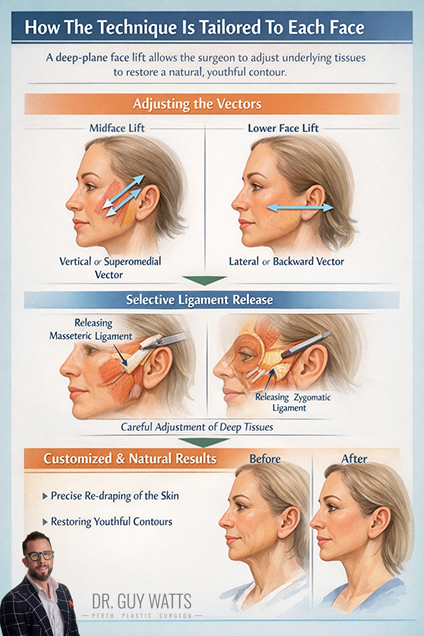
A deep-plane face lift surgery allows the surgeon to adjust the tissues that have changed position over time. This may involve releasing certain ligaments and repositioning the SMAS in a direction that supports better alignment between skin and underlying tissue.
For example, in cases where the midface has shifted, a vertical or superomedial vector may be used to reposition the deep tissues. Where the lower face has changed shape, a lateral or backward vector may be more appropriate. Dr Watts adjusts the technique according to what is observed in the operating room, based on prior planning.
During surgery, he may selectively release retaining ligaments such as the zygomatic and masseteric ligaments to allow the deeper structures to move. This is done with care to avoid overstretching tissues or placing tension in areas where it is not needed. The skin is then re-draped without excessive force.
This tailored approach is part of what makes the deep-plane face lift distinct. It allows changes to be made beneath the skin in a way that matches the face’s natural form and function.
Anaesthesia, Recovery And Ongoing Support
Deep-plane face lift procedures are typically performed under general anaesthesia, monitored by a qualified anaesthetist. This supports patient comfort and allows for accurate surgical work. Intraoperative monitoring continues throughout the procedure.
After surgery, patients are taken to recovery where early care is provided. Swelling and bruising are expected and may vary depending on the person’s health, age and tissue characteristics. Temporary changes in facial sensation or muscle strength may occur, but these often settle as part of the natural healing response.
Dr Watts provides written postoperative instructions and arranges follow-up appointments to observe healing and support recovery. These visits help identify and manage any concerns that may arise. The recovery process is gradual, and most changes unfold over several weeks to months.
Support is provided throughout this time, with the goal of guiding healing and promoting a recovery that aligns with the plan discussed before surgery.
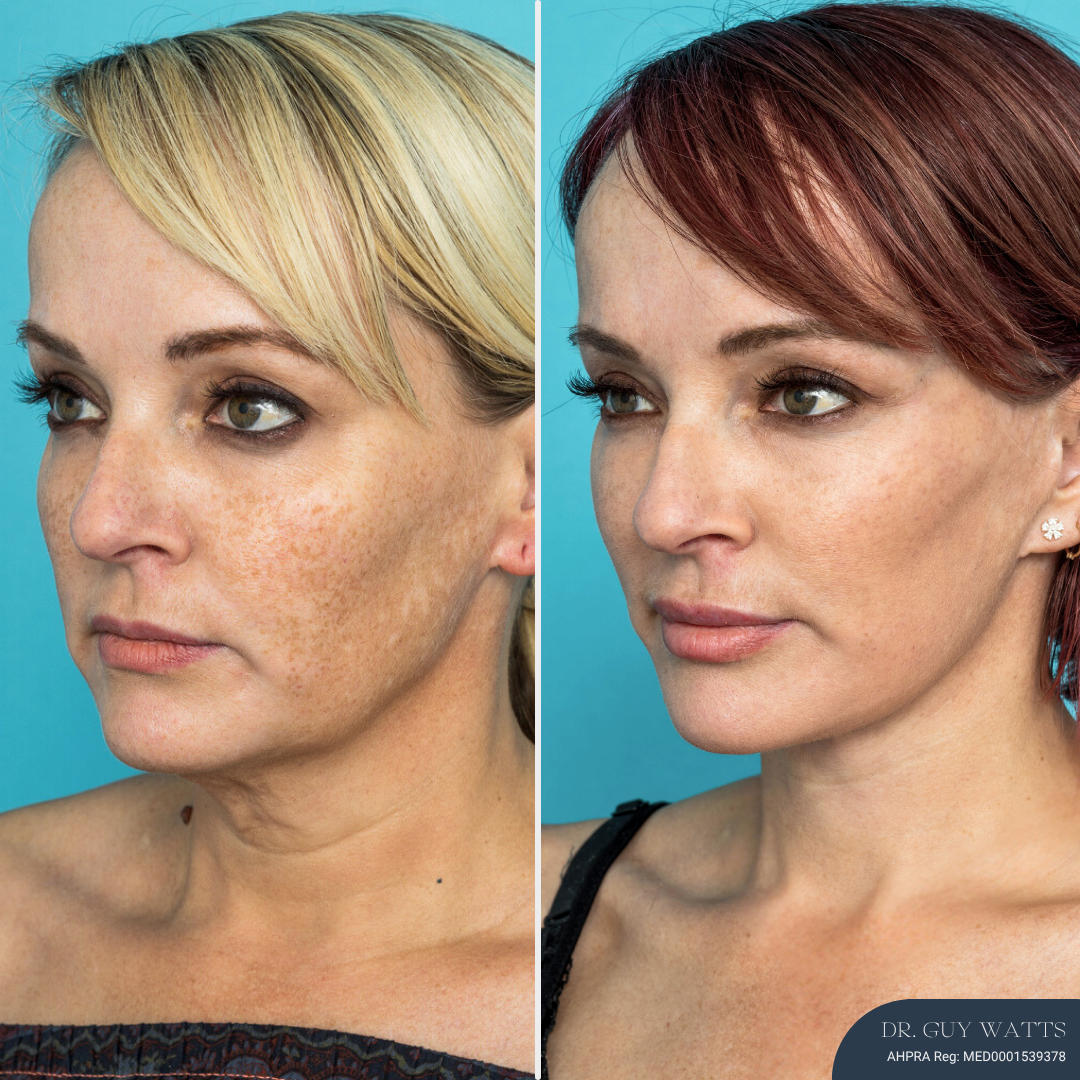
Face Lift Surgery Before and After Photos
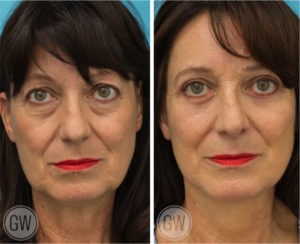
Photo disclaimer:
Each surgical procedure produces unique outcomes influenced by factors such as body composition, skin tone, laxity, age, and genetics. The before-and-after photographs displayed are of actual patients and are provided for informational purposes only.
Realistic Expectations And Responsible Communication
Understanding what a deep-plane face lift can and cannot achieve is an essential part of the process. Dr Watts discusses the potential outcomes with each patient in clear, honest terms. While the procedure can adjust certain facial tissues and support improved alignment, it does not stop the natural process of ageing or create permanent results.
Surgical outcomes are influenced by tissue type, skin health, lifestyle factors and genetics. Individuals who smoke, have sun-damaged skin or have medical conditions may experience different outcomes compared to those without these factors. These topics are explored openly during consultation.
Dr Watts does not use comparisons or emotional claims. The focus remains on evidence-based guidance, patient education and surgical planning. This approach promotes transparency and helps people make informed decisions that reflect their needs and goals.
Considerations Specific To Perth And Local Patients
In Perth, the climate and lifestyle can have a noticeable effect on skin and facial structure. High levels of UV exposure and outdoor activity may contribute to earlier signs of facial tissue change. Dr Watts takes this into account during assessment and planning.
Patients in Western Australia often value discretion, thorough information and practical care. Dr Watts’ clinic in Perth is structured to support these preferences, with local follow-up and consistent communication. This local access means patients do not need to travel long distances for ongoing care.
Working within the Perth medical community also allows Dr Watts to collaborate with referring doctors, skin specialists or allied health professionals when needed. This supports a coordinated and responsive approach to care before and after surgery.
Surgical Experience And A Structured Approach
Dr Guy Watts brings years of focused practice in facial surgery, with specialist training and extensive knowledge of facial anatomy. His approach to the deep-plane face lift includes:
- Clear understanding of facial nerve pathways
- Surgical technique that respects tissue planes
- Use of magnification and fine instruments
- Ongoing monitoring and postoperative care
- Individualised adjustments based on patient anatomy
- Open and responsible patient communication
Each decision is made with safety, planning and clarity in mind. The procedure is designed around the person, rather than fitting the person to the procedure.

FAQs About Deep-Plane Face Lift Safety And Surgical Planning
Thinking About Deep-Plane Face Lift Surgery In Perth
The deep-plane face lift may be considered by individuals in Perth who are seeking to address changes in facial support and shape that develop over time. It is not a solution for everyone, but it may be suitable for those looking to adjust deeper facial structures in a way that aligns with their anatomy.
Dr Guy Watts, Specialist Plastic & Reconstructive Surgeon in Perth, offers consultations to explore this procedure in detail. The process includes a full assessment, discussion of goals, and the development of a surgical plan tailored to the individual.
If you are thinking about this procedure and would like to understand whether it may be appropriate for you, consider booking a consultation with Dr Watts to explore your options in a responsible and supported way.
Further Reading
- Read more about Face Lift
- Read more about Brow Lift
- Read more about Facial Reconstruction
- Read Dr Guy Watts’ Blog on 7 Tips to Reduce Bruising after Facelift Surgery
- Read Dr Guy Watts’ Blog on When to Resume Exercising after Facelift Surgery
- Read Dr Guy Watts’ Blog on Recovery after Facelift Surgery
- Read Dr Guy Watts’ Blog on What is a Haemostatic Net?
About Dr. Guy Watts – MED0001539378
FRACS (Plas) – Specialist Plastic Surgeon In Perth WA

Dr. Guy Watts is a Specialist Plastic Surgeon (AHPRA MED0001539378) with an extensive career that spans across renowned plastic surgery clinics worldwide. His experience has been honed through invaluable experiences at esteemed establishments such as the New York Eye and Ear Infirmary and the renowned Pitanguy Clinic in Brazil.
Having collaborated with the foremost cosmetic plastic surgeons on a global scale, Dr. Watts has chosen to return to Perth after a 17-year journey of intensive training and invaluable professional experience to bring the latest practices and technology in cosmetic plastic surgery to his patients.
Dr. Watts is a Fellow of the Royal Australasian College of Surgeons (FRACS) and a Member of the Australian Society of Plastic Surgeons (ASPS), Australasian Society of Aesthetic Plastic Surgeons (ASAPS) and the International Society of Aesthetic Plastic Surgeons (ISAPS).
Read about the potential Risks and Complications of Surgery
Read the Patient Information and Resources
About CLINISPA
Clinispa is Dr Watts’ bespoke medical clinic performing Cosmetic Aesthetic treatments. At Clinispa, we offer advanced clinical treatments in a luxurious and calming environment, tailored to support your skin’s health and appearance.
Clinispa aesthetic services are performed by Dr Guy Watts’ nursing professionals, who have a passion for and solid understanding of facial aesthetics.
All Clinispa clients are considered individually, with a personalised treatment plan consisting of advanced scientific approaches to cosmetic aesthetics. We incorporate innovative technologies in conjunction with superiorly formulated skin care.
For more information about the full range of Clinispa Aesthetic of Cosmetic Treatments visit the Clinispa website
Sorry, the comment form is closed at this time.