


22 Aug Facial Surgery After Massive Weight Loss: Special Considerations
Substantial weight loss can change the distribution of facial fat, the way the skin sits over the underlying tissues and the relationship between the face and neck. Some people notice reduced volume through the cheeks or temples, more visible folds, or additional skin beneath the jaw after their weight has stabilised.
Dr Guy Watts is a Specialist Plastic and Reconstructive Surgeon in Perth, Western Australia. He assesses facial anatomy, weight stability, nutrition, previous bariatric treatment, general health and recovery requirements before discussing whether facial surgery may be appropriate.
How Can Massive Weight Loss Change My Face?
Substantial weight loss can reduce facial fat in the cheeks, temples, around the eyes and along the lower face. The change may be uneven because facial fat is divided into separate anatomical compartments that do not all respond in the same way. These anatomical relationships are discussed further in the guide to how facial fat compartments change over time.
A 2024 systematic review found that bariatric interventions can be associated with changes in facial soft-tissue volume and perceived facial ageing, although the available evidence remains limited and varies in methods and patient groups.
- Reduced midface or temple volume
- More visible under-eye shadows
- Changes around the mouth or jaw
- Additional skin beneath the chin
- Greater visibility of existing asymmetry
Why Do These Changes Vary Between Patients?
The degree of facial change depends on the amount and speed of weight loss, age, genetics, baseline facial structure and skin quality. Sun exposure, smoking and previous procedures can also influence how the tissues respond.
Two people who lose a similar amount of weight may therefore develop different facial changes. One may mainly notice reduced volume, while another may have more extensive skin and neck tissue changes.
- Starting facial fat distribution
- Amount and rate of weight loss
- Skin elasticity
- Bone and jaw structure
- Lifestyle and environmental exposure
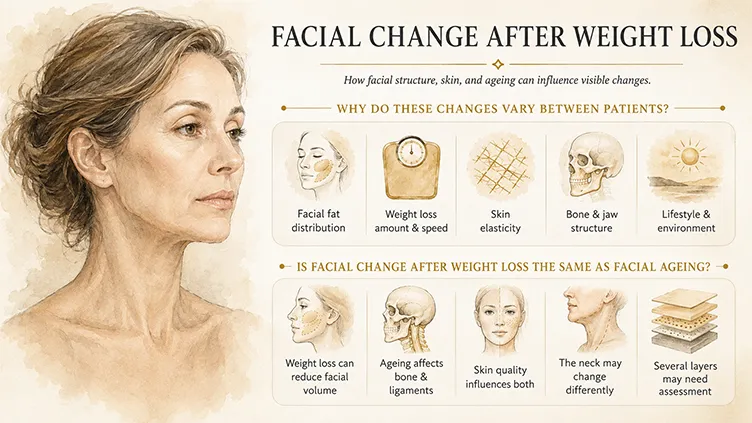
Is Facial Change After Weight Loss the Same as Facial Ageing?
Weight-loss-related facial changes and age-related changes can overlap, but they are not identical. Ageing develops gradually across bone, fat, ligaments, muscles and skin, while substantial weight loss may produce a more noticeable reduction in soft-tissue volume over a shorter period.
The two processes often occur together. Surgical planning must identify whether the main concern relates to volume reduction, tissue position, skin excess, muscle changes or several factors.
- Weight loss may reduce facial volume
- Ageing also affects bone and ligaments
- Skin quality influences both processes
- The neck may change at a different rate
- Several layers may require assessment
Why Can My Face Look More Hollow After Weight Loss?
Facial fat supports the cheeks, temples and eyelid-cheek transition. When selected compartments lose volume, the underlying bone structure and boundaries between facial regions may become more visible.
Hollowing may also appear greater when nearby areas retain volume. Fat loss is not uniform, so the face may show both reduced fullness and relatively prominent areas at the same time.
- Cheek projection may reduce
- Temples may appear less full
- Under-eye shadows may deepen
- Facial transitions can become sharper
- Natural bone structure may appear more visible
Does Skin Quality Change After Massive Weight Loss?
Research examining skin after substantial weight loss has identified changes involving collagen and elastic fibres. These findings help explain why skin may not contract fully after the underlying volume decreases.
The degree of skin adaptation varies. Age, sun exposure, smoking history, genetics and the duration of prior weight gain can all influence the response.
- Collagen organisation may change
- Elastic fibres can be affected
- Skin may appear thinner
- Contraction may be incomplete
- Healing capacity differs between patients
When Should I Consider a Facial Surgery Consultation?
A consultation may be considered once weight has stabilised and the facial changes are no longer evolving rapidly. There is no universal waiting period that applies to every patient.
The timing also depends on nutrition, medical stability and whether further weight reduction is planned. Surgery performed while weight is still changing may be affected by further changes in facial volume, skin and tissue position.
- Weight should be reasonably stable
- Further major weight loss should not be planned
- Health conditions should be managed
- Nutritional deficiencies require assessment
- Recovery support should be available
What Happens During My Consultation?
Dr Guy Watts reviews your weight history, method of weight loss, medical conditions, medications and previous operations. He also asks which facial or neck changes you have noticed and what you hope to understand.
The face and neck are examined at rest and during movement. Skin quality, fat distribution, muscle activity, facial structure and existing scars are considered together. When changes affect both regions, combined face and neck assessment may help determine whether treatment should address one area or both.
- Review bariatric and medical history
- Confirm weight stability
- Assess facial volume and skin
- Examine the face and neck together
- Discuss risks, alternatives and recovery
Which Facial Surgery Options May Be Discussed?
Possible procedures depend on the structures contributing to the concern. Selected patients may ask about face surgery, neck surgery, eyelid surgery or fat transfer.
No procedure addresses every post-weight-loss change. Some patients may benefit from one operation, while others may require a combined or staged plan.
- Face surgery for selected lower-face tissues
- Neck surgery for skin, fat or platysma changes
- Eyelid surgery for specific eyelid concerns
- Fat transfer for selected volume changes
- Staged surgery where appropriate
How Might Face Surgery Be Used After Weight Loss?
Facelift surgery may reposition selected deeper facial tissues and remove a measured amount of skin. In selected patients, a deep-plane facelift may be considered where deeper facial structures are part of the surgical plan. It may be discussed when the lower face shows tissue descent or skin excess that cannot be addressed through volume replacement alone.
The exact technique depends on the SMAS, ligament support, skin quality and previous procedures. Surgery does not simply involve pulling the skin more tightly.
- Deeper tissues may be repositioned
- Skin removal is measured
- Scar placement requires planning
- The neck may need separate assessment
- Existing asymmetry may remain
Face Lift Surgery Before and After Photos
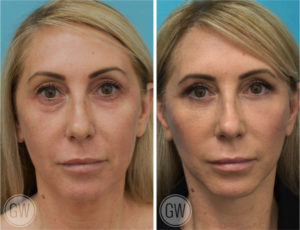
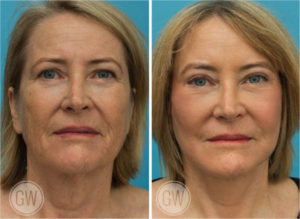
Photo disclaimer:
Each surgical procedure produces unique outcomes influenced by factors such as body composition, skin tone, laxity, age, and genetics. The before-and-after photographs displayed are of actual patients and are provided for informational purposes only.
What Are the Risks of Facial Surgery After Weight Loss?
Facial surgery risks depend on the procedure but may include bleeding, infection, delayed healing, visible scars, asymmetry and altered sensation. Face and neck surgery also carries a risk of injury to motor or sensory nerves.
Nutritional deficiencies, nicotine exposure and some medical conditions may increase surgical risk. No operation can guarantee a particular appearance or healing pattern.
- Bleeding or haematoma
- Infection or wound separation
- Altered sensation
- Nerve injury
- Further treatment or surgery
What Should I Expect During Recovery?
Bruising, swelling, tightness and temporary numbness are common after facial surgery. The extent and duration depend on which procedures were performed.
Many patients need assistance during the first several days and time away from work or social commitments. Early social recovery does not mean that all swelling and healing are complete. Patients considering a facelift can also review the facelift surgery recovery timeline.
- Rest with the head elevated
- Follow wound-care instructions
- Avoid strenuous activity
- Attend scheduled reviews
- Report increasing pain or swelling promptly
Download Dr Guy Watts’ Face and Neck Lift Surgery Guide
How Long Does Recovery Take?
Initial swelling and bruising often improve over the first few weeks, but residual swelling, firmness and sensory changes may last longer. Fat transfer can add further swelling.
Exercise and other activities are resumed gradually after clinical review. Scars continue changing for many months.
- First week: Wound review and reduced activity
- Two weeks: Some routine activities may resume
- Three to four weeks: Visible swelling may continue to reduce
- Six weeks: Activity may progress after clearance
- Several months: Tissues and scars continue settling

Facial Surgery After Massive Weight Loss FAQs
Take our quiz, and find out if you are ready for surgery
Why Might I Consult Dr Guy Watts?
Dr Guy Watts is a Specialist Plastic and Reconstructive Surgeon who assesses facial changes in the context of substantial weight loss, nutrition and overall health. Consultations are available through his Perth practice.
Australian Medical Board guidance requires appropriate assessment, informed consent and a referral from a GP or another medical specialist before cosmetic surgery.
- Specialist registration in Plastic Surgery
- Fellowship of the Royal Australasian College of Surgeons
- Combined face and neck assessment
- Individual surgical planning
- Perth-based follow-up care
How Do I Arrange a Consultation?
You can contact Dr Guy Watts’ Perth clinic to request an appointment. The clinic can explain current referral and consultation requirements.
Bring information about your weight loss, bariatric procedure, medications, supplements and previous facial treatments. Recent blood-test results may also be relevant.
- Obtain the required medical referral
- Gather bariatric records
- List medicines and supplements
- Bring relevant blood-test results
- Prepare questions before attending
Further Reading
- Read more about Deep Plane Facelift
- Read more about Deep Neck Lift Surgery Perth with Dr Guy Watts
- Read Dr Watts’ Blog on A Surgeon’s Guide To Facial Ligaments: Why They Matter In Facelifts
- Read Dr Watts’ Blog on How To Manage Face Lift Scars For Optimal Results
- Read Dr Watts’ Blog on Recovery After Facelift Surgery
- Read Dr Watts’ Blog on Facelift and Neck Lift in Perth: When Combined Surgery May Be Considered
About Dr. Guy Watts – MED0001539378
FRACS (Plas) – Specialist Plastic Surgeon In Perth WA

Dr. Guy Watts is a Specialist Plastic Surgeon (AHPRA MED0001539378) with an extensive career that spans across renowned plastic surgery clinics worldwide. His experience has been honed through invaluable experiences at esteemed establishments such as the New York Eye and Ear Infirmary and the renowned Pitanguy Clinic in Brazil.
Having collaborated with the foremost cosmetic plastic surgeons on a global scale, Dr. Watts has chosen to return to Perth after a 17-year journey of intensive training and invaluable professional experience to bring the latest practices and technology in cosmetic plastic surgery to his patients.
Dr. Watts is a Fellow of the Royal Australasian College of Surgeons (FRACS) and a Member of the Australian Society of Plastic Surgeons (ASPS), Australasian Society of Aesthetic Plastic Surgeons (ASAPS) and the International Society of Aesthetic Plastic Surgeons (ISAPS).
Read about the potential Risks and Complications of Surgery
Read the Patient Information and Resources
About CLINISPA
Clinispa is Dr Watts’ bespoke medical clinic performing Cosmetic Aesthetic treatments. At Clinispa, we offer advanced clinical treatments in a luxurious and calming environment, tailored to support your skin’s health and appearance.
Clinispa aesthetic services are performed by Dr Guy Watts’ nursing professionals, who have a passion for and solid understanding of facial aesthetics.
All Clinispa clients are considered individually, with a personalised treatment plan consisting of advanced scientific approaches to cosmetic aesthetics. We incorporate innovative technologies in conjunction with superiorly formulated skin care.
For more information about the full range of Clinispa Aesthetic of Cosmetic Treatments visit the Clinispa website
Sorry, the comment form is closed at this time.