

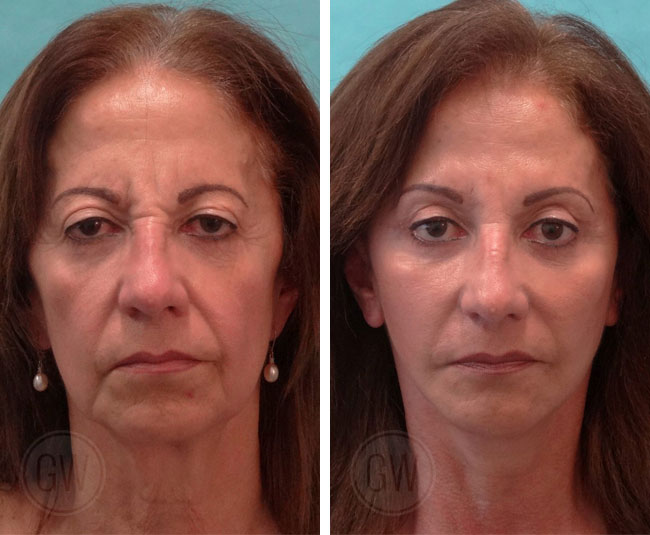
02 Aug How Facial Fat Compartments Change With Ageing
Facial ageing involves much more than changes to the skin. Over time, the facial bones, fat compartments, retaining ligaments, muscles, connective tissues and skin all change in different ways. These changes influence facial proportions, tissue position, movement and the relationship between the face and neck.
The pattern is different for every person. Dr Guy Watts is a Specialist Plastic and Reconstructive Surgeon in Perth, Western Australia, who assesses facial and neck ageing by considering the deeper anatomy as well as the visible surface changes. This article explains how those structures change and why surgical planning must be individualised.
What Does Structural Facial Ageing Mean?
Structural facial ageing refers to gradual changes affecting the deeper tissues that support the face and neck. These include bone, fat, ligaments, muscles and connective tissue, as well as the skin.
Visible folds or changes in facial shape usually reflect several layers changing at once. Ageing is therefore better understood as a combined anatomical process rather than a problem affecting the skin alone.
- Bone provides the framework
- Fat contributes volume and support
- Ligaments stabilise soft tissue
- Muscles influence movement
- Skin reflects the structures beneath it

How Is the Face Organised Into Layers?
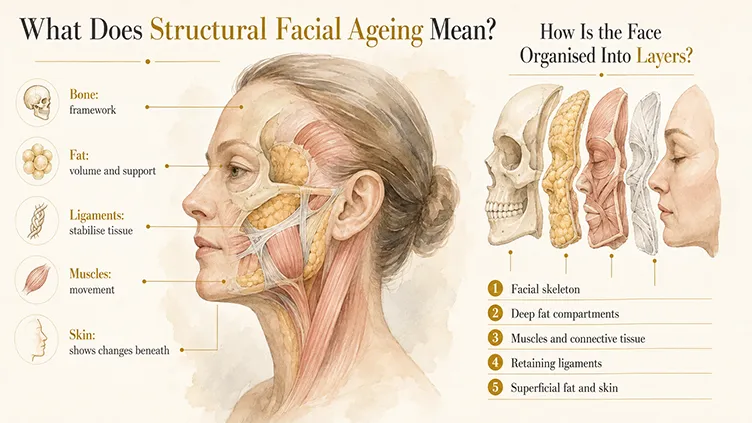
The face is made up of several connected layers. From deep to superficial, these include bone, deep fat, muscles and connective tissue, retaining ligaments, superficial fat and skin.
Each layer behaves differently with age. Changes in one layer can alter how the others sit, move or reflect light, which is why the same visible concern may have different causes in different people.
- Facial skeleton
- Deep fat compartments
- Muscles and connective tissue
- Retaining ligaments
- Superficial fat and skin
Why Does Facial Ageing Look Different for Everyone?
Facial ageing varies because people begin with different bone structures, fat distribution, skin thickness and facial proportions. These inherited features affect where changes become noticeable first.
Lifestyle and environmental factors also contribute. Sun exposure, smoking, weight fluctuation, health, dental changes and previous surgery can all influence the pattern.
- Genetics affect facial proportions
- Sun exposure changes skin quality
- Weight changes alter facial volume
- Smoking can accelerate skin changes
- Previous trauma may affect symmetry
What Happens to Facial Bones With Age?
Facial bones continue to remodel throughout adult life. Changes may occur around the eye sockets, cheeks, upper jaw, chin and lower jaw.
These skeletal changes are gradual and usually occur alongside changes in fat, ligaments and skin. Reduced bony support can alter how the overlying tissues sit.
- The eye sockets may widen
- Midface projection can reduce
- The jaw may change in height or shape
- Chin support may alter
- Soft tissues may sit differently
How Does the Midface Change Over Time?
The cheekbones and upper jaw support the central part of the face. Reduced projection in these areas can affect the cheeks, lower eyelids and tissues beside the nose.
Midface ageing often involves both bone and deep fat. This can change facial contours and the way light moves across the cheeks.
- Cheek projection may reduce
- The under-eye area may appear less supported
- Folds beside the nose may become more apparent
- Shadows can deepen
- Midface changes can influence the lower face
What Are Facial Fat Compartments?
Facial fat is divided into separate anatomical compartments rather than one continuous layer. These compartments have different locations and functions.
Deep fat sits closer to the facial skeleton and contributes support, while superficial fat lies closer to the skin and influences visible shape.
- Fat is arranged in distinct compartments
- Deep and superficial fat behave differently
- Some areas lose volume
- Others remain relatively stable
- Changes are not uniform
What Happens to Deep Facial Fat?
Deep fat compartments help support the cheeks and the transition between the lower eyelid and midface. Some compartments may gradually reduce in volume.
This can make the central cheek appear flatter or increase shadowing beneath the eyes. These changes may occur even when body weight remains stable.
- Cheek projection may reduce
- Under-eye hollowing can become more visible
- Facial transitions may appear sharper
- One compartment may change more than another
- Each side can behave differently
What Happens to Superficial Facial Fat?
Superficial fat contributes to the shape of the cheeks, temples and lower face. Some compartments may become thinner, while others remain full or appear more prominent.
This explains why ageing can involve hollowing in one area and fullness in another. It is not simply a process of losing facial fat everywhere.
- Some regions may appear flatter
- Other regions may remain full
- Lower-face fullness may become more visible
- Surface transitions can change
- Lighting may emphasise differences
Why Can the Lower Face Appear Fuller?
The lower face may appear fuller because of changes in superficial fat, ligament support, jaw structure and skin elasticity. Tissue does not simply move downward as one sheet.
Natural anatomy, weight and muscle activity also contribute. The cheeks, jaw and neck should therefore be assessed together.
- Jowl tissue may become more apparent
- Jaw support can change
- Skin may drape differently
- Localised fat may remain prominent
- Weight fluctuation may contribute
- Gravity acts on tissues with changing strength
Face Lift Surgery Before and After Photos
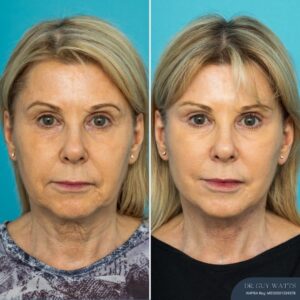
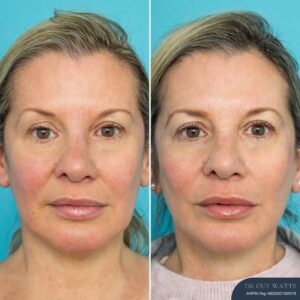
Photo disclaimer:
Each surgical procedure produces unique outcomes influenced by factors such as body composition, skin tone, laxity, age, and genetics. The before-and-after photographs displayed are of actual patients and are provided for informational purposes only.
How Do Facial Muscles Change With Age?
Facial muscles continue to control expression, blinking, speech and chewing. Repeated activity influences how the overlying skin folds during movement.
As skin elasticity decreases, expression lines may remain visible for longer. Muscle activity can also interact differently with tissues that have lost support.
- Repeated movement affects skin creases
- Muscle pull differs by region
- Resting tissue position may change
- Expression can emphasise asymmetry
- Function must be considered during surgery
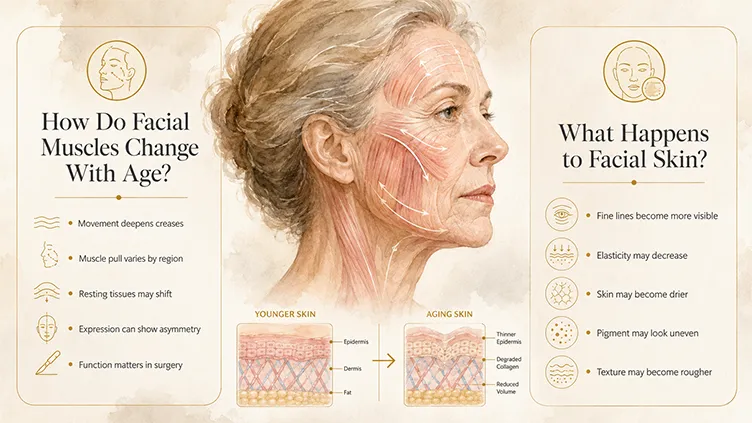
What Happens to Facial Skin?
Facial skin gradually becomes thinner, drier and less elastic. Collagen, elastin and other supporting components change, while moisture retention may decline.
Skin changes are visible, but they do not explain every shift in facial shape. The skin also adapts to changes occurring beneath it.
- Fine lines (rhytids) may become more visible
- Elasticity can decrease
- Skin may become drier
- Pigmentation may become uneven
- Texture may become rougher
Why Is the Neck Part of Facial Ageing?
The neck is connected to the lower face through skin, fat, muscles and connective tissue. Changes in one area can influence the appearance of the other.
For this reason, the lower face and neck are usually assessed together. Treating one region without considering the other may not address the structures contributing to the concern.
- The jaw and neck form a connected unit
- Skin continues from face to neck
- Fat can cross both regions
- The platysma influences neck shape
- Chin structure affects the neck profile
How Does Fat Affect the Neck?
Neck fat may sit above or below the platysma muscle. Its amount and position influence the relationship between the chin, jaw and neck.
Fat removal alone does not address every neck concern. Skin quality, muscle position and skeletal anatomy must also be assessed.
- Fat may sit beneath the chin
- Deeper fat may lie below the platysma
- Distribution differs between individuals
- Skin may not contract fully
- Bone structure influences the neck angle
Download Dr Guy Watts’ Face and Neck Lift Surgery Guide
When Might Surgery Be Considered?
Surgery may be discussed when structural changes contribute to concerns that cannot be addressed through surface-focused care alone. Suitability depends on anatomy, health and informed expectations rather than age.
Possible procedures vary according to the tissues involved. Surgery may reposition soft tissue, remove selected skin or fat, or address muscle changes, but it does not stop ageing.
- Facial tissue repositioning may be discussed
- Neck surgery may address selected structures
- Eyelid surgery may be considered separately
- Fat transfer may be appropriate in selected areas
- Some patients may not require surgery
Why Is Planning Based on Anatomy Rather Than Trends?
Similar-looking concerns can arise from different anatomical causes. A change beneath the jaw may relate to fat, muscle, skin, bone structure or a combination.
Planning based on trends or photographs of other people may therefore create unrealistic expectations. Individual assessment is required.
- Bone structure differs between patients
- Fat compartments vary
- Skin quality is individual
- Muscle anatomy affects technique
- One procedure does not suit every face
Does Facial Surgery Stop Ageing?
Facial surgery does not stop the ageing process. It changes selected tissues at a particular point in time, after which the face and neck continue to change.
How long the surgical change remains apparent depends on tissue quality, health, sun exposure, weight variation and the procedure performed.
- Age-related change continues
- Skin quality remains relevant
- Weight changes can alter volume
- Sun exposure affects the skin
- Further surgery is not automatically required

FAQs About How Ageing Changes The Face And Neck
Take our quiz, and find out if you are ready for surgery
Why Might I Consult Dr Guy Watts About Facial and Neck Ageing?
Dr Guy Watts is a Specialist Plastic and Reconstructive Surgeon who assesses facial and neck changes across several anatomical layers. His Perth consultations focus on explaining which structures may be contributing.
Choosing a surgeon should involve checking qualifications and discussing the proposed procedure, alternatives, risks, scars and recovery. Decisions should not rely on comparisons or guaranteed outcomes.
- Specialist registration in Plastic Surgery
- Fellowship of the Royal Australasian College of Surgeons
- Combined face and neck assessment
- Individual surgical planning
- Perth-based follow-up care
How Do I Arrange a Consultation?
You can contact Dr Guy Watts’ Perth clinic to request an appointment. The clinic can explain current referral and consultation requirements.
Bring a medication list and details of previous facial procedures, skin treatments or relevant medical conditions. Preparing notes about the changes you have observed can help guide the discussion.
Further Reading
- Read more about Gliding Brow Lift
- Read more about SMAS Facelift
- Read more about Deep Neck Lift Surgery Perth with Dr Guy Watts
- Read Dr Watts’ Blog on Facelift Longevity: How Long Results Last And What Influences Them
- Read Dr Watts’ Blog on How Age, Lifestyle And Skin Care Can Influence The Outcome Of A Facelift
- Read Dr Watts’ Blog on How Surgeons Address the Jawline During Facelift and Neck-Lift Surgery
About Dr. Guy Watts – MED0001539378
FRACS (Plas) – Specialist Plastic Surgeon In Perth WA

Dr. Guy Watts is a Specialist Plastic Surgeon (AHPRA MED0001539378) with an extensive career that spans across renowned plastic surgery clinics worldwide. His experience has been honed through invaluable experiences at esteemed establishments such as the New York Eye and Ear Infirmary and the renowned Pitanguy Clinic in Brazil.
Having collaborated with the foremost cosmetic plastic surgeons on a global scale, Dr. Watts has chosen to return to Perth after a 17-year journey of intensive training and invaluable professional experience to bring the latest practices and technology in cosmetic plastic surgery to his patients.
Dr. Watts is a Fellow of the Royal Australasian College of Surgeons (FRACS) and a Member of the Australian Society of Plastic Surgeons (ASPS), Australasian Society of Aesthetic Plastic Surgeons (ASAPS) and the International Society of Aesthetic Plastic Surgeons (ISAPS).
Read about the potential Risks and Complications of Surgery
Read the Patient Information and Resources
About CLINISPA
Clinispa is Dr Watts’ bespoke medical clinic performing Cosmetic Aesthetic treatments. At Clinispa, we offer advanced clinical treatments in a luxurious and calming environment, tailored to support your skin’s health and appearance.
Clinispa aesthetic services are performed by Dr Guy Watts’ nursing professionals, who have a passion for and solid understanding of facial aesthetics.
All Clinispa clients are considered individually, with a personalised treatment plan consisting of advanced scientific approaches to cosmetic aesthetics. We incorporate innovative technologies in conjunction with superiorly formulated skin care.
For more information about the full range of Clinispa Aesthetic of Cosmetic Treatments visit the Clinispa website
Sorry, the comment form is closed at this time.