


09 Jul How Surgeons Address the Jawline During Facelift and Neck-Lift Surgery
At his specialist practice in Perth, Western Australia, Dr Guy Watts sees individuals seeking information about how an anterior neck lift, deep neck lift or facelift may influence the structure and appearance of the jawline. While facial surgery is often discussed in terms of skin or wrinkles, the shape of the jawline plays a significant role in how people perceive facial balance. The lower third of the face is an area where ageing may contribute to visible changes, and for many individuals, these changes prompt an interest in a refreshed and proportionate appearance.
For Dr Guy Watts, adjusting the jawline is not a one-size-fits-all approach. With more than 15 years of surgical experience and extensive training in Plastic and Reconstructive Surgery, including advanced fellowship training in New York and Toronto, Canada, Dr Watts tailors every procedure to each individual’s anatomy and treatment goals. Whether through a neck lift, a facelift, or a combination of both, he applies detailed anatomical knowledge and clinical judgement to plan procedures that maintain balance and proportion across the face.
This article will walk you through how the jawline is assessed and approached during these procedures, what techniques may be used, and how each decision is informed by safety and appropriate planning.
Why the Jawline Plays a Role in Facial Balance
The jawline defines the transition between the face and neck. When the underlying structures of the lower face change due to ageing, weight variation or individual anatomical differences, the clarity in this area may reduce. This can lead to changes in soft tissue position or accumulation of skin and fat that obscure the distinction between the jaw and neck.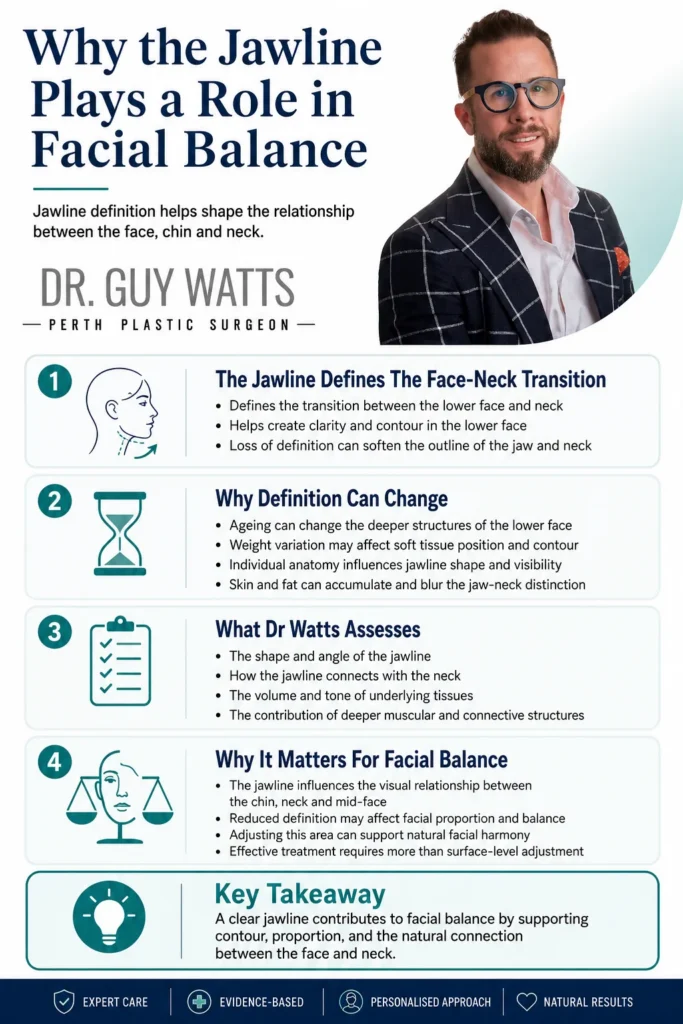
In approaching procedures for this area, Dr Watts pays close attention to the shape and angle of the jawline, how it connects with the neck and the volume and tone of the underlying tissues. Because this region involves not only the skin but also deeper muscular and connective structures, achieving a clearer jawline requires more than surface-level adjustment.
The importance of the jawline extends beyond appearance alone. It contributes to overall facial balance. A jawline that lacks clear definition may alter the visual relationship between the chin, neck and mid-face. Adjusting this area can support proportion and draw attention to the natural features of the face.
A Closer Look at the Neck Lift
A neck lift focuses specifically on the area beneath the jaw and across the front and sides of the neck. The goal is to modify soft tissues, address muscle tone and remove excess skin that contributes to changes in this region.
Dr Watts begins by assessing the platysma muscle, which runs from the jaw to the collarbone and may change position or tone over time. When this muscle separates or becomes more visible, it can influence the definition of the jawline. During a neck lift, Dr Watts can adjust and support the platysma to re-establish soft tissue support in this area.
In many individuals, particularly those with volume beneath the chin or along the jaw, there may also be a build-up of fatty tissue. Depending on the person, this may be addressed through carefully targeted liposuction or surgical removal. This step can support a clearer transition between the neck and jaw.
Once the underlying tissues are addressed, the skin is re-draped and adjusted to follow the new foundation. Excess skin is removed where necessary. Incisions are typically placed around the ears or under the chin in a way that promotes discreet healing.
Understanding How a Facelift Affects the Jawline
While a deep neck lift may address structures beneath the jaw, a facelift addresses areas of the lower and mid-face and may also influence the appearance of the jawline. With age, the tissues of the lower face may change position, leading to an uneven appearance along the jawline where skin and underlying fat accumulate.
A facelift involves repositioning deeper tissues, including the SMAS (superficial musculoaponeurotic system), a supportive layer beneath the skin. By adjusting the SMAS rather than relying on the skin alone, the procedure can help support longer-term structural changes.
This repositioning is tailored to the individual’s anatomy. The objective is to lift the tissues in a direction that supports facial balance and helps clarify the angle where the lower face meets the neck. After repositioning, excess skin is gently removed, and the remaining skin is secured without creating tension. Incisions are placed around the ears and within the hairline.
By combining SMAS repositioning with neck lift techniques, it is often possible to address changes both above and below the jawline in a unified way. This approach can contribute to a smoother transition across the lower face and neck.
Combining Techniques With Care and Precision
Dr Watts applies an approach grounded in clinical experience and specialist training in both reconstructive and aesthetic surgery. Each step of the procedure is chosen after careful evaluation and based on the individual’s anatomy.
Common techniques used during neck lift or facelift surgery to support jawline clarity include:
- Platysma muscle adjustment: Modifying and supporting this muscle can help define the angle between the neck and jaw.
- SMAS repositioning: Lifting the SMAS layer supports structural changes that may assist with reducing soft tissue descent along the jawline.
- Fat modification: Excess fatty tissue in the lower face and under the chin may be altered or repositioned to better align with the rest of the facial structure.
- Skin adjustment: Once the deeper layers are repositioned, the overlying skin is redraped and excess is carefully removed. This helps support a smooth surface without relying on skin tension alone.
Dr Watts does not use a standardised template for any of these methods. Each plan is developed around the individual patient’s presentation and informed by what will best support their facial balance.
DOWNLOAD DR GUY WATTS’ FACE AND NECK LIFT SURGERY GUIDE
The Value of a Personalised Assessment
Each person’s facial structure, skin tone and goals are different. This is why individualised planning is a core part of Dr Watts’ approach in Perth.
Assessment includes a detailed physical examination, a review of medical history and clinical photography. During consultation, Dr Watts discusses:
- Chin projection and bone structure
- Skin resilience and thickness
- Distribution of facial volume
- Position and function of the platysma muscle
- Facial symmetry and proportion
This helps determine whether a neck lift, facelift or combination of both will be appropriate. In some cases, other procedures may also be discussed to support balance across the lower face. Dr Watts clearly explains all proposed steps, potential risks and what each option involves so individuals feel fully informed.
Take our quiz, and find out if you are ready for surgery
Face and Neck Lift Surgery Before and After Photos
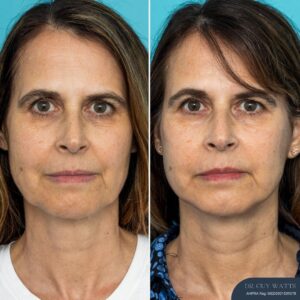
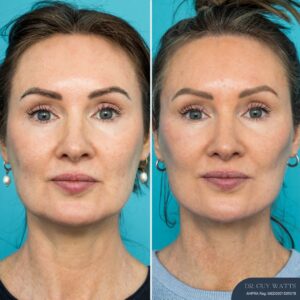
View more facelift and neck-lift before-and-after photographs.
Photo disclaimer:
Each surgical procedure produces unique outcomes influenced by factors such as body composition, skin tone, laxity, age, and genetics. The before-and-after photographs displayed are of actual patients and are provided for informational purposes only.
What Recovery Can Involve
Recovery following a neck lift or facelift is an important phase that contributes to how the face adjusts and settles after surgery. Common experiences in the early phase may include swelling, bruising and tightness. These responses generally begin to ease within the first few weeks.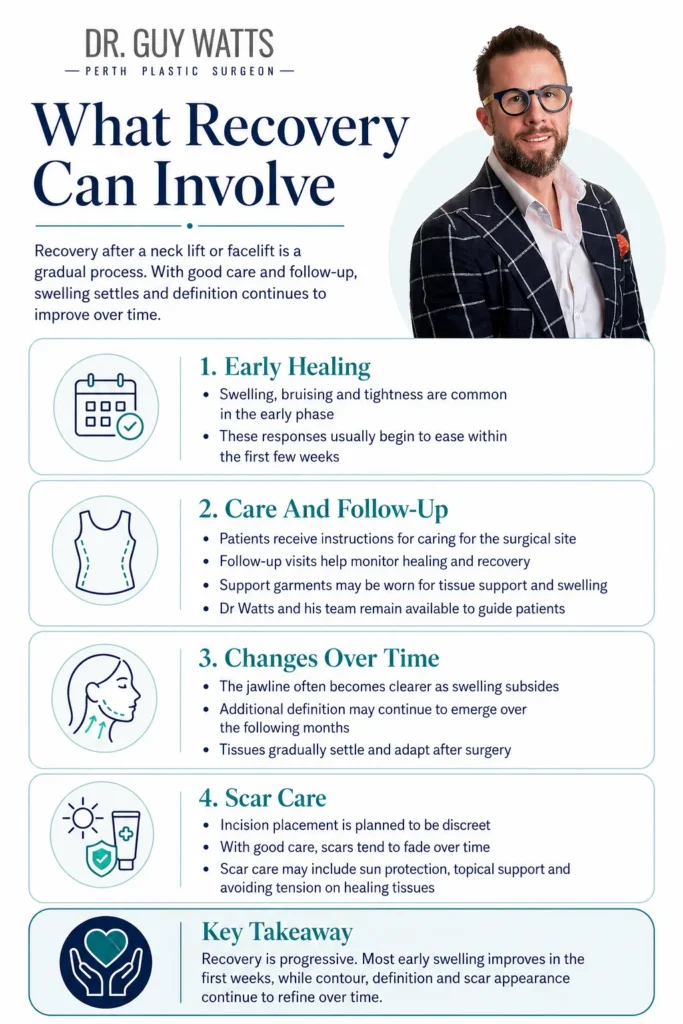
Patients are given instructions on caring for the surgical site and when to attend follow-up visits. Support garments may be worn for a time to help with tissue support and swelling. Dr Watts and his team remain available throughout the recovery process to guide patients and answer questions.
The jawline begins to become clearer as swelling subsides, typically within the first few weeks. Additional definition may continue to emerge in the following months as the tissues settle and adapt.
Incision placement is planned to be discreet, and with good care, the resulting scars tend to fade over time. Scar care measures including sun protection, topical support and avoiding tension on healing tissues are discussed during follow-up.
A Considered Approach to Jawline Adjustment
Refining the jawline involves more than surface change. It relies on the surgeon’s ability to understand underlying anatomy and how each adjustment interacts with other parts of the face. Dr Guy Watts uses a considered, evidence-informed approach in his Perth clinic that aligns surgical technique with individual features and preferences.
Rather than focusing on sharp definition or creating dramatic change, the goal is to support clarity in the lower face in a way that maintains overall proportion. This often means adjusting more than one layer of tissue and selecting the appropriate approach based on anatomical relationships.
Dr Watts remains current with evolving surgical research and techniques, applying this knowledge in ways that are personalised, measured and clinically sound.

FAQs About Jawline Planning During Facelift and Neck-Lift Surgery
Achieving Harmony, Not Perfection
When individuals seek changes in their jawline, the reasons are highly personal. Dr Watts focuses on supporting proportion and balance, rather than aiming for uniform results. In each case, the objective is to adjust areas of the lower face in ways that feel consistent with the person’s broader facial features.
The idea of a single ideal jawline does not apply. Instead, Dr Watts works with patients to understand what changes are possible and appropriate for their features. The consultation process is designed to give individuals the space and information they need to make well-considered choices.
Taking the First Step With a Specialist in Perth
If you have been considering how a neck lift or facelift might change the appearance of your lower face, arranging a consultation with a qualified surgeon is the first step.
Dr Guy Watts, based in Perth, welcomes individuals of all backgrounds to his clinic to explore their options in a supportive and respectful setting. During your consultation, you will have the opportunity to ask questions, view surgical plans and gain a better understanding of what might be suitable for you.
There is no obligation to proceed. Instead, the aim is to provide information and clarity so you can make a choice that aligns with your personal goals and preferences. If you would like to begin this conversation, contact Dr Watts’ clinic in Perth to arrange a consultation and learn more about what may be possible for you.
Further Reading
- Read more about Anterior Neck Lift
- Read more about Facelift Surgery
- Read more about Deep Neck Lift Surgery Perth with Dr Guy Watts
- Read Dr Guy Watts’ Blog on Facelift and Neck Lift in Perth: When Combined Surgery May Be Considered
- Read Dr Guy Watts’ Blog on Facelift Longevity: How Long Results Last And What Influences Them
- Read Dr Guy Watts’ Blog on Scar Management After Plastic Surgery
About Dr. Guy Watts – MED0001539378
FRACS (Plas) – Specialist Plastic Surgeon In Perth WA

Dr. Guy Watts is a Specialist Plastic Surgeon (AHPRA MED0001539378) with an extensive career that spans across renowned plastic surgery clinics worldwide. His experience has been honed through invaluable experiences at esteemed establishments such as the New York Eye and Ear Infirmary and the renowned Pitanguy Clinic in Brazil.
Having collaborated with the foremost cosmetic plastic surgeons on a global scale, Dr. Watts has chosen to return to Perth after a 17-year journey of intensive training and invaluable professional experience to bring the latest practices and technology in cosmetic plastic surgery to his patients.
Dr. Watts is a Fellow of the Royal Australasian College of Surgeons (FRACS) and a Member of the Australian Society of Plastic Surgeons (ASPS), Australasian Society of Aesthetic Plastic Surgeons (ASAPS) and the International Society of Aesthetic Plastic Surgeons (ISAPS).
Read about the potential Risks and Complications of Surgery
Read the Patient Information and Resources
About CLINISPA
Clinispa is Dr Watts’ bespoke medical clinic performing Cosmetic Aesthetic treatments. At Clinispa, we offer advanced clinical treatments in a luxurious and calming environment, tailored to support your skin’s health and appearance.
Clinispa aesthetic services are performed by Dr Guy Watts’ nursing professionals, who have a passion for and solid understanding of facial aesthetics.
All Clinispa clients are considered individually, with a personalised treatment plan consisting of advanced scientific approaches to cosmetic aesthetics. We incorporate innovative technologies in conjunction with superiorly formulated skin care.
For more information about the full range of Clinispa Aesthetic of Cosmetic Treatments visit the Clinispa website
Sorry, the comment form is closed at this time.