


29 Oct Fine vs Heavy Neck Bands: Different Surgical Approaches
Vertical neck bands are usually related to the platysma, a broad, thin muscle extending from the upper chest into the lower face. They may appear only during facial movement or remain visible when the neck is relaxed.
The terms “fine” and “heavy” are useful descriptions rather than formal diagnoses. Dr Guy Watts is a Specialist Plastic and Reconstructive Surgeon in Perth, Western Australia, who assesses the muscle, skin, fat, jaw structure and surrounding neck tissues before discussing whether surgery may be appropriate.
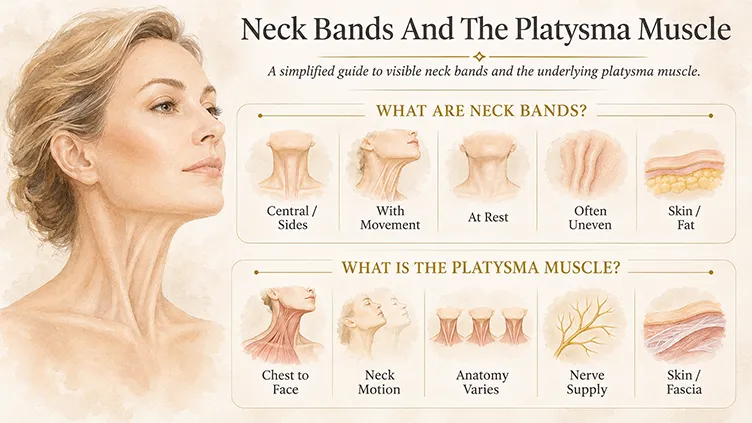
What Are Neck Bands?
Neck bands are vertical cords or ridges that become visible at the front or sides of the neck. They are commonly formed by parts of the platysma projecting forwards during contraction.
Real-time ultrasound studies suggest that tissue within a visible band thickens and projects during muscle activity, while the surrounding platysma behaves differently. This supports the view that banding is related to three-dimensional muscle mechanics rather than skin change alone.
- May appear centrally or towards the sides
- Can be visible only during movement
- May remain apparent at rest
- Often differ between the two sides
- Can occur alongside skin or fat changes
What Is the Platysma Muscle?
The platysma is a thin, paired muscle covering much of the front and sides of the neck. It contributes to lower-face expression and movement of the skin and soft tissues beneath the jaw.
Its anatomy is more complex than a single flat sheet. Anatomical studies describe variable attachments and segmental nerve supply, including regions where surgical dissection requires particular care.
- Extends from the upper chest towards the lower face
- Contributes to neck and lower-face movement
- Has individual anatomical variations
- Receives segmental nerve supply
- Interacts with skin, fat and deeper fascia
Why Do Neck Bands Develop?
Neck bands may become visible because of muscle contraction, separation between the medial platysma edges, changes in surrounding tissue support or a combination of these factors. Their exact development remains an area of ongoing anatomical study.
Ageing is only one influence. Some younger people display prominent bands because of inherited anatomy or strong platysma activity, while others develop them later alongside skin laxity and changes in neck fat.
- Platysma contraction
- Separation between muscle edges
- Reduced support from surrounding tissues
- Individual muscle anatomy
- Changes in skin and fat
What Is the Difference Between Fine and Heavy Neck Bands?
“Fine” generally describes narrower or less prominent bands, while “heavy” describes more prominent bands. Either may become more noticeable during movement or remain visible at rest. Appearance alone does not establish the underlying anatomy or determine which treatment, if any, is appropriate.
This distinction does not automatically dictate a specific operation. A narrow band may still reflect substantial muscle activity, while a broader neck change may involve skin, fat, glands or skeletal anatomy in addition to the platysma.
- Fine bands: Often more movement-dependent
- Heavy bands: More likely to remain visible at rest
- Fine bands: May be limited to one region
- Heavy bands: May occur with wider neck changes
- Both types: Require examination during movement
How Are Fine Neck Bands Assessed?
Fine bands are assessed while the neck is relaxed and while the patient speaks, smiles or contracts the platysma. This helps determine whether the feature is mainly dynamic or also visible at rest.
Dr Guy Watts also examines skin quality, neck fat, asymmetry and the relationship between the chin, jaw and neck. A fine visible line is not necessarily caused by a single isolated muscle edge.
- Observe the neck at rest
- Assess movement and contraction
- Compare both sides
- Examine skin thickness and elasticity
- Check for associated fat or jaw factors
How Are Heavy Neck Bands Assessed?
Heavy bands require assessment of the full lower face and neck because persistent vertical cords often occur alongside broader anatomical changes. These may include skin redundancy, platysma separation, localised fat or deeper neck fullness.
Contemporary reviews emphasise that neck surgery may involve several structures, including the platysma, fat, digastric muscles and submandibular glands. Not every patient requires treatment of each structure.
- Width and position of the bands
- Visibility at rest
- Degree of platysma separation
- Skin and fat distribution
- Deeper neck anatomy
How Do Fine Bands Differ From Horizontal Neck Lines?
Vertical neck bands usually follow the direction of platysma fibres and may become more visible during contraction. Horizontal neck lines are folds or creases running across the skin.
A patient may have both. Treating the platysma does not necessarily remove horizontal skin creases, and skin-directed treatment does not correct a contracting muscle band.
- Vertical bands are usually muscle-related
- Horizontal lines are mainly skin creases
- Both may coexist
- Each requires separate assessment
- One procedure may not address both
Can Fine Neck Bands Be Treated Through a Small Incision?
Selected central bands may be approached through a short incision beneath the chin. This provides access to the medial platysma and nearby submental tissues.
A small incision does not mean the operation is minor or appropriate for every patient. If changes extend towards the sides of the neck or involve loose skin, additional access may be required.
- Submental access may reach the central neck
- Scar placement is beneath the chin
- Skin removal is limited through this approach
- Lateral tissues may remain untreated
- Suitability depends on the full anatomy
What Is Platysma Plication?
Platysma plication uses sutures to bring selected muscle edges or segments closer together. A midline plication is sometimes used where separation of the medial platysma contributes to central banding.
The sutures reshape the muscle but do not alter every cause of neck fullness or laxity. Excessive tension or an unsuitable suture pattern may create tightness or contour irregularity.
- Uses internal sutures
- May join medial muscle edges
- Can be performed through submental access
- Does not remove loose skin
- Must account for muscle movement
When Might Plication Be Considered for Fine Bands?
Plication may be discussed when the main finding is limited medial platysma separation and the skin retains reasonable elasticity. It may also be considered when the surrounding neck anatomy does not require broader treatment.
A fine band visible mainly during movement is not automatically an indication for surgery. The expected degree of change must be weighed against the scar, recovery and surgical risks.
- Limited central muscle separation
- Relatively localised banding
- No substantial skin redundancy
- No major deeper-neck contribution
- Informed acceptance of surgical limitations
Can Limited Liposuction Be Added?
Limited submental liposuction may be considered when superficial fat contributes to fullness around the central neck. It is planned separately from treatment of the platysma.
Removing fat does not correct a muscle band, and excessive removal can reveal underlying structures more clearly. Skin contraction and deeper neck anatomy must be considered before combining the procedures.
- Treats selected superficial fat
- Does not repair the platysma
- May alter how bands appear
- Requires adequate skin behaviour
- Must be performed conservatively
Why Might Heavy Bands Need a Broader Operation?
Heavy or persistent bands may reflect wider platysma involvement and associated skin or soft-tissue changes. Treating only the central muscle may leave lateral neck or lower-face findings unaddressed.
A broader operation can provide access for lateral platysma adjustment, skin repositioning and assessment of other neck structures. The extent should remain proportionate to the anatomical findings.
- Wider muscle separation
- Persistent bands at rest
- Associated skin redundancy
- Lower-face or jaw changes
- Additional neck structures involved
What Is Midline Platysmaplasty?
Midline platysmaplasty involves exposing and modifying the medial platysma through a submental incision. Sutures may be used to bring the edges together and create a more continuous muscle layer.
Several variations have been described, including plication, partial division and other muscle-shaping techniques. Reviews have not established one universally appropriate method for every pattern of banding.
- Central access beneath the chin
- Muscle edges are identified
- Sutures may be placed in the midline
- Fat may be assessed separately
- Technique varies by anatomy
What Is Lateral Platysma Support?
Lateral support involves accessing the platysma through incisions around the ears and repositioning it towards a stable fixation point. It may be incorporated into face and neck surgery.
This approach addresses tissues beyond the central neck. It may be combined with midline work when both central banding and broader lower-face or neck change are present.
- Uses access near the ears
- Repositions lateral platysma
- May affect the lower face and jaw
- Can accompany central repair
- Requires longer incisions
Does Every Heavy Band Require Muscle Division?
No. Muscle division, myotomy or complete transection represents one category of platysma management, but it is not required for every patient.
Published techniques include plication, suspension, partial division and complete transection. The available evidence does not establish that the most extensive approach is always preferable, and each carries different anatomical implications.
- Plication may be sufficient in some cases
- Partial division may be considered
- Complete transection is more extensive
- Recurrence remains possible
- Technique selection requires individual judgement
When Might Deeper Neck Structures Need Assessment?
In selected patients, deeper fat, digastric muscles or submandibular glands may contribute to neck fullness. Assessment of these structures is separate from assessing the visible platysma bands.
Deep-neck surgery increases complexity and introduces additional risks. It should not be performed solely because a neck band appears heavy.
- Provides access to deeper structures
- May address deep fat
- Can involve digastric assessment
- May include gland-related planning
- Requires a specific anatomical indication
Can Loose Skin Be Treated at the Same Time?
Skin may be repositioned when laxity contributes to the neck change. This usually requires incisions around or behind the ears rather than only beneath the chin.
The skin should not be used as the sole source of support when deeper tissues require treatment. Excessive skin tension may affect scars and tissue position.
- Skin is assessed separately from muscle
- Ear-area incisions may be required
- Excess skin can be measured and removed
- Deeper tissues may require independent support
- Scars are permanent
Are Fine Bands Easier to Treat Than Heavy Bands?
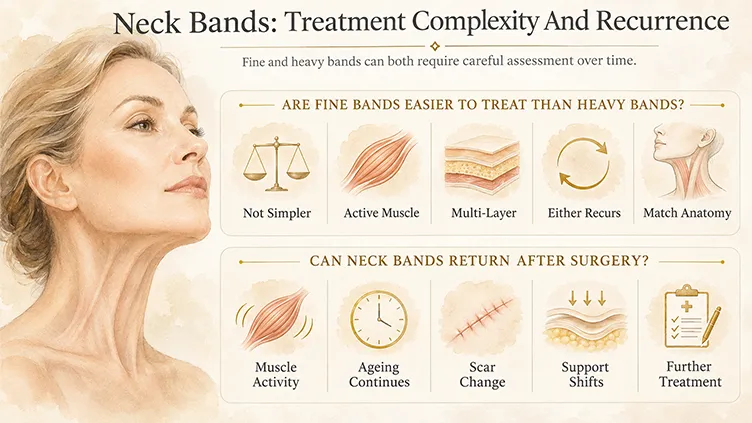
Fine bands are not automatically easier to treat. A narrow, highly active band may be difficult to change without affecting surrounding muscle behaviour, while a heavier band may be part of a more clearly defined structural pattern.
The relevant question is not which band looks smaller, but which anatomical structures are contributing and what degree of surgery would be required.
- Visibility does not equal complexity
- Dynamic bands can be strongly active
- Heavy bands may involve several layers
- Recurrence can occur with either type
- Treatment must match the anatomy
Can Neck Bands Return After Surgery?
Platysma bands can recur or become visible again as tissues heal and continue to change. Muscle activity, scar behaviour, ageing and the surgical technique may all influence recurrence.
No method can guarantee permanent elimination of banding. Studies examining transection and other methods continue to reflect ongoing debate about durability and the appropriate extent of surgery.
- Muscle activity continues
- Ageing does not stop
- Scar tissue can change
- Tissue support may alter
- Further treatment may sometimes be considered
What Are the Risks of Neck Band Surgery?
Risks include bleeding, haematoma, infection, delayed healing, visible scars, asymmetry, contour irregularity and altered sensation. Muscle surgery may also produce tightness, tethering or recurrence.
The platysma has segmental innervation, and neck surgery occurs near nerves controlling lower-face movement. More extensive dissection may also expose deeper structures and increase operative demands.
- Bleeding or fluid collection
- Wound-healing concerns
- Numbness or sensitivity
- Lower-lip movement changes
- Further surgery
How Is My Neck Examined During Consultation?
Dr Guy Watts examines the neck at rest and during facial expression. He assesses the platysma, skin, superficial and deep fat, jaw and chin support, scars and the relationship between the lower face and neck.
The purpose is to determine whether the visible bands are fine, heavy, dynamic, persistent or part of a broader anatomical pattern. Consultation does not create an obligation to proceed.
- Review health and medications
- Observe the neck during movement
- Assess skin and fat
- Examine jaw and chin structure
- Discuss risks, scars and alternatives
When Might Surgery Not Be Appropriate?
Surgery may not be appropriate when the likely anatomical change is limited, the medical risks are excessive or expectations do not match what the operation can achieve. Nicotine use may also increase healing complications.
A band that appears only occasionally may not justify an operation with permanent scars and recognised risks. Choosing observation remains a valid decision.
- Uncontrolled medical conditions
- Current nicotine use
- Unclear anatomical indication
- Unrealistic expectations
- Insufficient recovery support
Neck Lift Surgery Before and After Photos
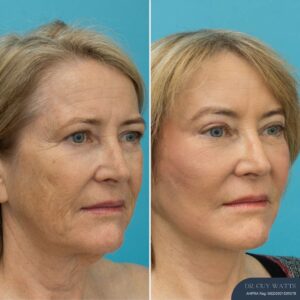
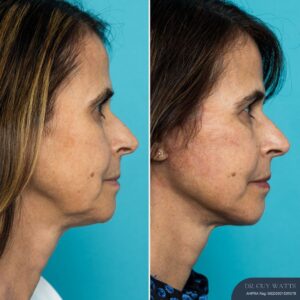
Photo disclaimer:
Each surgical procedure produces unique outcomes influenced by factors such as body composition, skin tone, laxity, age, and genetics. The before-and-after photographs displayed are of actual patients and are provided for informational purposes only.
What Should I Expect During Recovery?
Swelling, bruising, tightness and temporary numbness are common after platysma surgery. The extent of recovery depends on whether the operation is limited to the central neck or includes lateral and deeper dissection.
A supportive garment may be prescribed, and exercise remains restricted during early healing. Contact the surgical team promptly for increasing pain, worsening swelling or new lower-face weakness. Seek emergency medical care immediately for breathing difficulty or rapidly increasing neck swelling.
- Rest with the head elevated
- Follow dressing instructions
- Wear the garment if prescribed
- Avoid strenuous activity
- Attend scheduled reviews
How Long Does Recovery Take?
A limited central procedure may have a shorter recovery than a combined face and neck operation, but individual healing varies. Early bruising and swelling commonly improve over several weeks.
Firmness, altered sensation and residual swelling may persist for longer. Scars continue to change over many months.
- First week: Wound and swelling review
- Two weeks: Some routine activities may resume
- Four weeks: Swelling continues to reduce
- Six weeks: Activity may progress after clearance
- Several months: Tissues continue settling

FAQs About Fine Vs Heavy Neck Bands
Take our quiz, and find out if you are ready for surgery
Why Might I Consult Dr Guy Watts?
Dr Guy Watts is a Specialist Plastic and Reconstructive Surgeon who assesses the platysma in relation to the face, jaw, skin and deeper neck anatomy. He provides consultations through his Perth practice.
Choosing a surgeon should involve checking specialist qualifications and discussing the proposed technique, scars, recovery, alternatives and procedure-specific risks.
- Specialist registration in Plastic Surgery
- Fellowship of the Royal Australasian College of Surgeons
- Combined face and neck assessment
- Individual surgical planning
- Perth-based follow-up care
How Do I Arrange a Consultation?
You can contact Dr Guy Watts’ Perth clinic to request an appointment. The clinic can explain current referral and consultation requirements.
Bring a medication list and details of previous facial or neck surgery, threads, liposuction or injectable treatments. Photographs showing when the bands are most visible may also assist discussion.
- Contact the Perth clinic
- Obtain any required referral
- Gather previous treatment records
- List medicines and supplements
- Prepare questions before attending
Download Dr Guy Watts’ Face and Neck Lift Surgery Guide

Further Reading
- Read more about Deep Neck Lift Surgery Perth with Dr Guy Watts
- Read Dr Guy Watts’ Blog on Anterior Neck-Lift Surgery: When It’s Considered And Why
About Dr. Guy Watts – MED0001539378
FRACS (Plas) – Specialist Plastic Surgeon In Perth WA

Dr. Guy Watts is a Specialist Plastic Surgeon (AHPRA MED0001539378) with an extensive career that spans across renowned plastic surgery clinics worldwide. His experience has been honed through invaluable experiences at esteemed establishments such as the New York Eye and Ear Infirmary and the renowned Pitanguy Clinic in Brazil.
Having collaborated with the foremost cosmetic plastic surgeons on a global scale, Dr. Watts has chosen to return to Perth after a 17-year journey of intensive training and invaluable professional experience to bring the latest practices and technology in cosmetic plastic surgery to his patients.
Dr. Watts is a Fellow of the Royal Australasian College of Surgeons (FRACS) and a Member of the Australian Society of Plastic Surgeons (ASPS), Australasian Society of Aesthetic Plastic Surgeons (ASAPS) and the International Society of Aesthetic Plastic Surgeons (ISAPS).
Read about the potential Risks and Complications of Surgery
Read the Patient Information and Resources
About CLINISPA
Clinispa is Dr Watts’ bespoke medical clinic performing Cosmetic Aesthetic treatments. At Clinispa, we offer advanced clinical treatments in a luxurious and calming environment, tailored to support your skin’s health and appearance.
Clinispa aesthetic services are performed by Dr Guy Watts’ nursing professionals, who have a passion for and solid understanding of facial aesthetics.
All Clinispa clients are considered individually, with a personalised treatment plan consisting of advanced scientific approaches to cosmetic aesthetics. We incorporate innovative technologies in conjunction with superiorly formulated skin care.
For more information about the full range of Clinispa Aesthetic of Cosmetic Treatments visit the Clinispa website
Sorry, the comment form is closed at this time.