

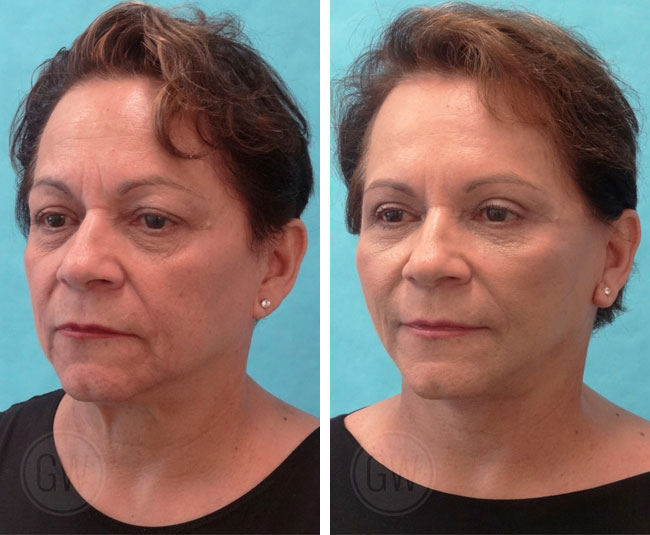
16 Jul Facelift vs Mini Facelift: Key Differences, Limitations and Suitability
Facial features naturally change over time. For many women and men in Perth and surrounding areas, these gradual shifts can prompt consideration of surgical options that provide structural support to the face. While some individuals may initially explore non-surgical treatments, others find that a surgical approach may be more suitable to address deeper anatomical changes.
Two procedures commonly discussed are the facelift and the mini or partial facelift. Although they share similarities, they differ in their extent, purpose, and suitability. Understanding these distinctions is essential for making an informed decision that reflects both your facial structure and your personal preferences.
Dr Guy Watts is a Specialist Plastic and Reconstructive Surgeon (FRACS) based in Perth, Western Australia. With specialist training in New York and Toronto, 15 years of clinical experience, and a focused practice in facial surgery, Dr Watts works closely with patients to explore their options through a medically guided and respectful process.
This article offers a detailed comparison of the facelift and mini/partial facelift. It outlines what each procedure involves, who it may be suitable for, and how to determine which approach aligns with your goals and facial characteristics.
Understanding Facial Ageing Over Time
Facial ageing occurs gradually and often varies between individuals. A combination of genetic factors, sun exposure, lifestyle, and anatomy contributes to the rate and nature of these changes.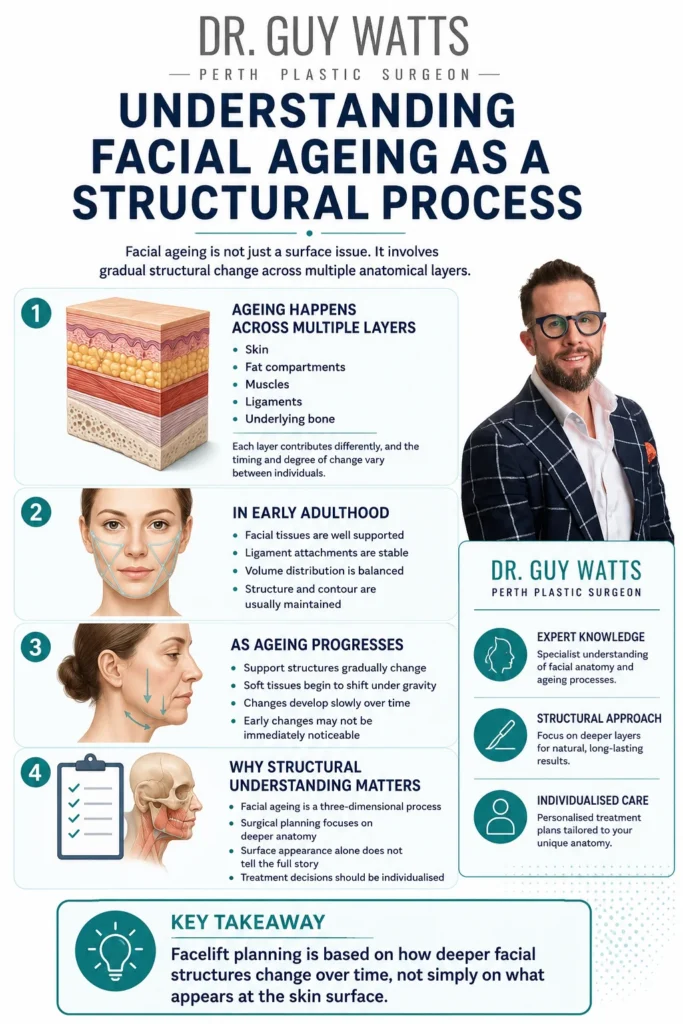
With time, skin may become less elastic due to reduced collagen and elastin production. Soft tissues beneath the skin can gradually shift or reduce in volume. Ligaments that provide support to facial structures may begin to relax. In addition, the bones that form the foundation of the face, particularly around the eyes, cheeks, and jawline, may undergo subtle but significant changes.
These changes do not always occur uniformly. Some people notice early changes near the jawline or cheek area, while others experience more prominent structural softening in the neck. Because of this variation, a personalised facial assessment with a Specialist Plastic and Reconstructive Surgeon is essential to determine what changes are occurring and whether a surgical procedure may be suitable.
What Is A Facelift?
A facelift, also known as a rhytidectomy, is a surgical procedure that aims to address visible structural changes in the lower two-thirds of the face and, in some cases, the neck. It involves modifying deeper tissues to support facial structure and provide a refreshed appearance that reflects each individual’s natural anatomy.
Rather than focusing solely on the skin, a facelift addresses the superficial musculoaponeurotic system (SMAS), which is a layer of connective tissue beneath the skin. Adjusting the SMAS allows for more structural support that is less dependent on skin tension and more aligned with the natural foundation of the face.
During the procedure, incisions are usually made around the ears and sometimes extend discreetly into the hairline. The deeper tissue layer is adjusted, the skin is gently repositioned, and any excess skin is carefully removed. If there are visible changes in the neck, these may also be addressed in the same procedure.
Facelifts are performed under general anaesthesia. Recovery usually involves a period of progressive healing. Swelling, changes in sensation, and bruising are expected in the initial stages and gradually resolve over time. Follow-up care and guidance are provided to support healing and monitor your progress.
It’s important to note that a facelift does not change the fundamental structure of the face or improve skin quality. The procedure works by supporting underlying anatomy and addressing tissue changes that develop with time.
What Is A Mini Facelift?
A mini facelift or rather a partial facelift, is a less extensive face surgery option designed for individuals who have early or moderate structural changes in the lower face. It may be suitable for people who have noticed changes near the jawline or lower cheek but who do not require broader tissue adjustment across the midface or neck.
This procedure uses a shorter incision, often placed just in front of the ear, and involves a more localised adjustment of soft tissues. In some cases, the SMAS layer is also addressed, although in a more focused way than with a full facelift.
A mini facelift may be considered by individuals in their late 30s to early 50s, particularly when early facial changes are present and the neck area does not yet require surgical attention. While the recovery period can be shorter compared to a traditional facelift, healing times vary and depend on each patient’s anatomy and general health.
The mini facelift is not a scaled-down version of a facelift. It is a distinct procedure with its own indications, limitations, and goals. It may offer appropriate support in specific circumstances, especially when subtle structural change is the main concern.
Facelift Vs Mini Facelift: Key Differences
Although both procedures aim to address visible changes in facial structure, there are significant differences in scope, technique, and suitability.
A facelift is generally recommended for individuals with more advanced or widespread changes, including noticeable changes along the jawline, visible tissue descent in the midface, or softening in the neck. This approach allows for comprehensive tissue adjustment across multiple areas and can support the face and neck together when needed.
A mini facelift is better suited to individuals with localised changes in the lower face who do not yet require intervention for the neck or deeper tissues. It offers a more targeted approach, which may be beneficial earlier in the ageing process.
The surgical technique also differs. A facelift uses longer incisions and allows for broader access to underlying structures. A mini facelift uses a smaller incision and involves less dissection. As a result, the range of adjustment is more limited.
Recovery is another consideration. While both procedures require time for healing, a facelift generally involves a longer recovery period due to the extent of the surgery. A mini facelift may involve less swelling and a shorter recovery phase, but individual healing varies. Dr Watts advises all patients to plan for adequate recovery time based on their personal circumstances and to avoid making assumptions about how quickly they will feel ready to return to usual activities.
Outcomes from both procedures are influenced by skin elasticity, facial anatomy, and lifestyle. A facelift may provide longer-lasting support due to the depth of tissue adjustment. A mini facelift may offer more subtle support for those in earlier stages of facial change. Neither procedure is permanent, and natural ageing will continue over time. However, the procedures may support facial structure in a way that aligns with the patient’s stage of life and anatomical features.
DOWNLOAD DR GUY WATTS’ FACE AND NECK LIFT SURGERY GUIDE
Who Might Consider Each Procedure?
Suitability for either procedure is not based on age alone. At his Perth practice, Dr Guy Watts assesses each patient based on a number of factors, including skin elasticity, volume distribution, bone structure, and the specific areas of the face that have changed over time.
A mini facelift may be appropriate for someone with early changes limited to the lower face, where the neck and midface are still well supported. A facelift may be recommended for individuals who have more prominent tissue descent across several areas or who are looking for a more comprehensive approach to facial support.
Medical history, lifestyle, and ability to accommodate recovery time are also considered. Every individual is assessed carefully to determine whether surgery is appropriate and which procedure is likely to align with their preferences and expectations.
What To Expect During A Consultation With Dr Guy Watts
When attending a consultation with Dr Watts, patients are provided with clear, evidence-based information about surgical options. Each consultation involves a detailed facial assessment, review of personal and medical history, and a discussion about what changes are visible and how they might be addressed surgically.
Dr Watts explains the differences between a facelift and a mini facelift, what each procedure involves, and what the recovery process may include. There is also a discussion about surgical risks, including scarring, swelling, temporary changes in sensation, and the need for a realistic understanding of outcomes.
Patients are encouraged to ask questions and take time to consider their options. There is no obligation to proceed. The goal is to support individuals in making informed decisions based on their anatomy, medical suitability, and personal values.
Take our quiz, and find out if you are ready for surgery
Face Lift Surgery Before and After Photos
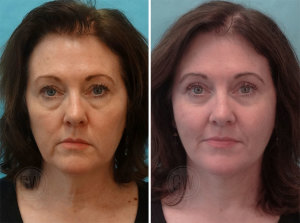
Photo disclaimer:
Each surgical procedure produces unique outcomes influenced by factors such as body composition, skin tone, laxity, age, and genetics. The before-and-after photographs displayed are of actual patients and are provided for informational purposes only.
Supporting Natural Facial Movement
An important aspect of facial surgery is maintaining the ability to express emotion and communicate naturally. Dr Watts takes great care to plan procedures in a way that supports natural facial movement.
Surgical adjustments are performed with consideration for the direction of movement, the role of underlying muscles, and the overall balance of the face. The aim is not to create change for its own sake, but to work within each person’s existing structure in a way that respects both function and form.
Incisions are placed in areas where they are likely to be less noticeable, and tension is minimised to reduce the chance of tightness or irregularity. The goal is to achieve an outcome that is consistent with your facial identity and expression.
Preparing For Surgery
Preparation is an important step before any surgical procedure. Patients will receive instructions tailored to their needs. These may include stopping certain medications, avoiding nicotine, and planning for time off work or other responsibilities.
It’s also important to arrange transport, post-operative care, and a quiet environment for recovery. Dr Watts and his team provide detailed information to help patients prepare physically and logistically.
Good preparation contributes to a well-supported recovery and helps reduce the chance of delays or complications during the healing process.

FAQs About Facelift Vs Mini Facelift
What A Facelift or Mini Facelift Recovery Involves
Recovery following facial surgery varies from person to person. Swelling and bruising are expected during the first few weeks. Changes in sensation, such as numbness or tightness, are also common and tend to settle over time.
Patients are advised to rest, avoid physical exertion, and follow all aftercare instructions carefully. Follow-up appointments are scheduled to monitor progress and provide support throughout the recovery phase.
Most patients return to non-physical activities within a few weeks, depending on their recovery rate and the nature of the procedure. Dr Watts provides clear guidance at every stage to help patients navigate the process.
Trends In Facial Surgery In Perth
In recent years, there has been a noticeable increase in interest around structural facial surgery in Perth. Many patients are looking for longer-term support options after exploring non-surgical treatments. There is also a greater focus on choosing a qualified Specialist Plastic and Reconstructive Surgeon who offers an evidence-based, personalised approach.
Patients are more informed and cautious. They want to understand the reasons for facial changes and what surgical options may offer, without pressure or unrealistic expectations.
Dr Watts has observed that patients often feel more comfortable with surgical options once they understand that the aim is to support underlying structure, not to dramatically change appearance.
Further Reading
- Read more about Facelift Surgery
- Read more about Anterior Neck Lift
- Read more about Deep Plane Facelift
- Read Dr Guy Watts’ Blog on Facelift Longevity: How Long Results Last And What Influences Them
- Read Dr Guy Watts’ blog on How Age, Lifestyle and Skin Care May Influence Facelift Results.
- Read Dr Guy Watts’ Blog on Can A Face Lift Look Natural? Understanding Today’s Techniques For Facial Balance
- Read Dr Guy Watts’ Blog on Facial Surgery Trends in Australia: What Patients Are Asking
About Dr. Guy Watts – MED0001539378
FRACS (Plas) – Specialist Plastic Surgeon In Perth WA

Dr. Guy Watts is a Specialist Plastic Surgeon (AHPRA MED0001539378) with an extensive career that spans across renowned plastic surgery clinics worldwide. His experience has been honed through invaluable experiences at esteemed establishments such as the New York Eye and Ear Infirmary and the renowned Pitanguy Clinic in Brazil.
Having collaborated with the foremost cosmetic plastic surgeons on a global scale, Dr. Watts has chosen to return to Perth after a 17-year journey of intensive training and invaluable professional experience to bring the latest practices and technology in cosmetic plastic surgery to his patients.
Dr. Watts is a Fellow of the Royal Australasian College of Surgeons (FRACS) and a Member of the Australian Society of Plastic Surgeons (ASPS), Australasian Society of Aesthetic Plastic Surgeons (ASAPS) and the International Society of Aesthetic Plastic Surgeons (ISAPS).
Read about the potential Risks and Complications of Surgery
Read the Patient Information and Resources
About CLINISPA
Clinispa is Dr Watts’ bespoke medical clinic performing Cosmetic Aesthetic treatments. At Clinispa, we offer advanced clinical treatments in a luxurious and calming environment, tailored to support your skin’s health and appearance.
Clinispa aesthetic services are performed by Dr Guy Watts’ nursing professionals, who have a passion for and solid understanding of facial aesthetics.
All Clinispa clients are considered individually, with a personalised treatment plan consisting of advanced scientific approaches to cosmetic aesthetics. We incorporate innovative technologies in conjunction with superiorly formulated skin care.
For more information about the full range of Clinispa Aesthetic of Cosmetic Treatments visit the Clinispa website
Sorry, the comment form is closed at this time.