

07 Aug Facial Surgery Trends in Australia: What Patients Are Asking
Interest in facial surgery is increasingly accompanied by detailed questions about anatomy, recovery, limitations and long-term planning. Rather than requesting one standard result, many patients want to understand which facial structures have changed and whether surgery can address those changes without disregarding their existing features.
Dr Guy Watts is a Specialist Plastic and Reconstructive Surgeon in Perth, Western Australia. During facial surgery consultations, he assesses the skin, fat compartments, muscles, supporting tissues and facial skeleton before discussing whether an operation may be appropriate. This article examines the topics patients are currently raising and the factors that should guide responsible surgical planning.
What Do “Facial Surgery Trends” Actually Mean?
A facial surgery trend may describe a change in the procedures people ask about, the information they seek or the way surgeons plan an operation. It should not be interpreted as a reason to undergo surgery or as evidence that one technique suits every patient.
Current surgical literature shows continuing interest in face and neck procedures that address deeper supporting structures, but there remains debate about the relative advantages and risks of different techniques. Individual anatomy and surgeon assessment remain more important than the popularity of a procedure.
- Greater interest in anatomical explanations
- More questions about long-term tissue change
- Increased discussion of combined procedures
- Attention to recovery and ongoing care
- Less reliance on one standard surgical plan
Why Are Patients Seeking More Detailed Information?
Patients now have access to extensive online information, before-and-after images and discussions about facial procedures. This can improve familiarity with terminology, but it can also create confusion when techniques are presented without clinical context.
During consultation, patients often want help distinguishing between medically supported information and promotional claims. Australian cosmetic surgery advertising guidance requires balanced information that does not minimise risks or create unreasonable expectations.
- What does the procedure actually address?
- Which claims are supported by evidence?
- What are the material risks?
- How extensive is the recovery?
- What alternatives should be considered?
Are People Consulting About Facial Surgery Earlier?
Some patients seek advice before they are ready to proceed with surgery. Their purpose may be to understand facial changes, possible timing and how future health or lifestyle plans could affect their options.
An earlier consultation does not mean that surgery is required. It may establish that monitoring, skin care or no intervention is appropriate at that time.
- Learning which tissues are changing
- Discussing the likely progression of those changes
- Understanding scars and recovery
- Reviewing previous facial treatments
- Planning around work or family responsibilities
Does Age Determine When Facial Surgery Is Appropriate?
Chronological age alone does not determine suitability for facial surgery. Two people of the same age can have different bone structure, skin quality, fat distribution and medical risk. These differences are also relevant when considering facelift surgery in the 40s, 50s and 60s, where surgical planning is based on individual anatomy rather than age alone.
Assessment focuses on anatomy, health, nicotine exposure, medications and whether the proposed operation addresses the patient’s concern. A younger or older age does not automatically support or exclude surgery.
- Facial anatomy varies widely
- Skin quality changes at different rates
- General health affects surgical risk
- Previous procedures influence planning
- Expectations must match the likely result
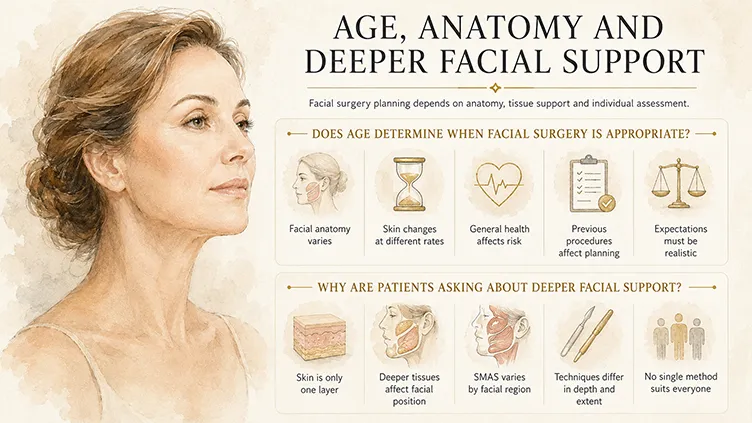
Why Are Patients Asking About Deeper Facial Support?
Visible facial changes often involve more than the skin. The superficial musculo-aponeurotic system, or SMAS, is a fibromuscular layer beneath the skin and superficial fat that contributes to facial tissue organisation.
Imaging research has identified measurable age-related changes in SMAS thickness, although these findings do not determine the correct procedure for an individual. Surgeons may discuss deeper tissue repositioning when anatomy supports it rather than relying only on skin tension.
- Skin is only one anatomical layer
- Deeper tissues influence facial position
- The SMAS differs across facial regions
- Techniques vary in depth and extent
- No method is appropriate for every patient
Are SMAS and Deep-Plane Techniques the Same?
SMAS and deep-plane procedures both involve tissues beneath the skin, but they are not identical. The dissection plane, ligament release and method of tissue repositioning differ.
Recent reviews continue to compare these approaches, but the most suitable method remains debated because available studies differ in patient selection, outcome measurement and complication reporting.
- Different anatomical planes are involved
- Incision patterns may be similar
- Dissection extent varies
- Recovery can differ
- Surgeon training and patient anatomy matter
Why Are Patients Asking to Avoid a “Pulled” Appearance?
Patients commonly want facial surgery to respect their existing features and avoid excessive skin tension. A visibly tight result can occur when planning does not adequately account for deeper anatomy, tissue quality or the direction of repositioning.
No surgeon can guarantee that another person will interpret a result in a particular way. The more useful discussion concerns what tissues will be adjusted, where scars will sit and what degree of change is realistically possible.
- How will deeper tissue be managed?
- How much skin will be removed?
- Where will tension be placed?
- Will facial movement be affected?
- What limitations apply to my anatomy?
Why Are Face and Neck Procedures Often Discussed Together?
The lower face and neck are connected through skin, fat, the platysma muscle and supporting tissues. Where lower face and jawline changes are part of the concern, facelift surgery may be discussed as one of the available surgical approaches following individual assessment. A change around the jaw can therefore be related to structures in both regions.
For selected patients, assessing the face and neck together may produce a more coherent surgical plan. This does not mean both areas must always be operated on.
- Jaw and neck tissues are connected
- Platysma changes can affect both regions
- Fat may sit above or below the muscle
- Chin projection influences neck appearance
- One region may require more treatment than the other
Are Combined Facial Procedures Becoming More Common?
Patients often ask whether several concerns can be addressed during one operation. Examples may include face and neck surgery, upper and lower eyelid surgery, or facial tissue repositioning with fat transfer.
Combining procedures can create one anaesthetic and initial recovery period, but it also increases operative time and recovery demands. The decision must be based on health, procedure extent and overall risk rather than convenience alone.
- One coordinated surgical plan
- One initial hospital admission
- Longer operating time
- Broader recovery requirements
- Staging may be more appropriate in some cases
Why Are Patients Asking About Eyelid Surgery?
Changes around the eyelids can affect the upper lid, lower lid, brow and eyelid-cheek junction. Patients may describe heaviness, skin folds, under-eye fullness or altered shadows.
Blepharoplasty addresses selected eyelid tissues but does not correct every brow, cheek or skin-quality concern. Examination is needed to identify which structures contribute.
- Upper-eyelid skin may fold differently
- Fat position can change
- Brow descent may affect the upper lid
- Lower-eyelid support must be assessed
- Dry-eye symptoms require discussion
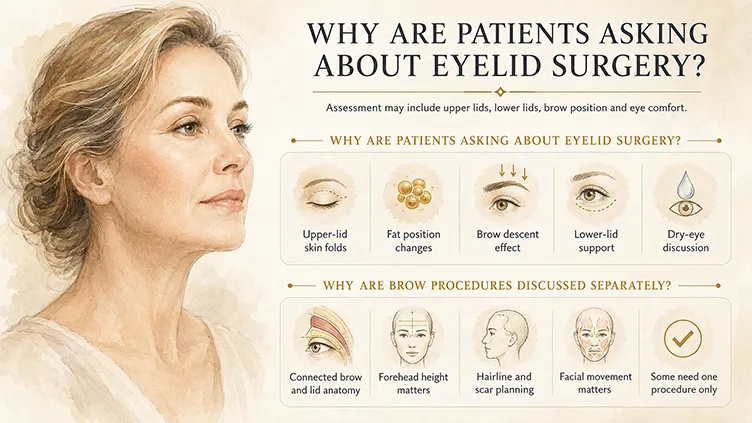
Why Are Brow Procedures Discussed Separately?
A brow procedure changes brow position, while upper-eyelid surgery addresses selected eyelid tissues. The procedures may be discussed together, but they are not interchangeable.
Removing upper-eyelid skin cannot always compensate for a low brow. Equally, altering brow position may not address all eyelid concerns.
- Brow and eyelid anatomy are connected
- Forehead height influences planning
- Hairline and scar placement matter
- Facial movement must be considered
- Some patients require only one procedure
Why Are Patients Asking About Facial Fat Transfer?
Facial fat transfer involves removing fat from another body area, processing it and placing selected amounts into facial tissues. It may be discussed where volume change contributes to a patient’s concern.
Not all transferred fat remains permanently, and the degree of retention is variable. Fat transfer also does not replace surgery when tissue position or skin excess is the main issue.
- May address selected volume changes
- Requires a donor area
- Retention is unpredictable
- Swelling can persist
- Further treatment may occasionally be considered
Are More Men Asking About Facial Surgery?
Men may seek advice about eyelids, the lower face, jaw or neck, but gender alone does not determine the surgical plan. Hair pattern, beard-bearing skin, tissue thickness and skeletal anatomy may affect incision placement and technique.
The consultation should focus on the individual’s anatomy and concerns rather than assumptions about how a man or woman should look.
- Beard distribution affects scar planning
- Hairline position may influence incisions
- Skin thickness differs between patients
- Jaw and chin anatomy require assessment
- Personal priorities vary
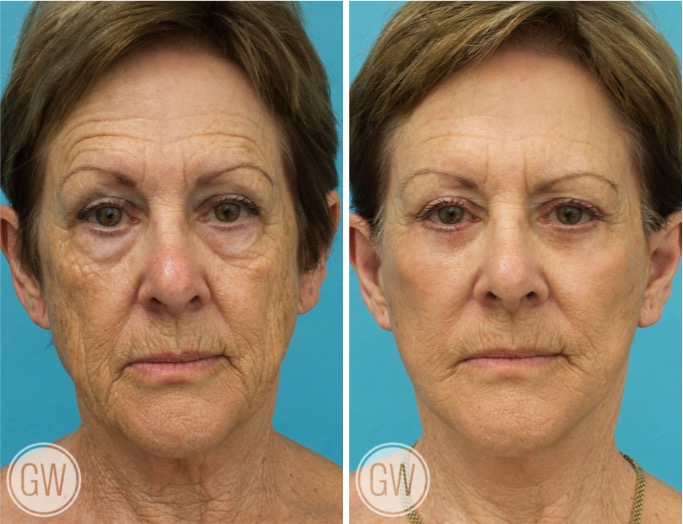
Face Lift Surgery Before and After Photos
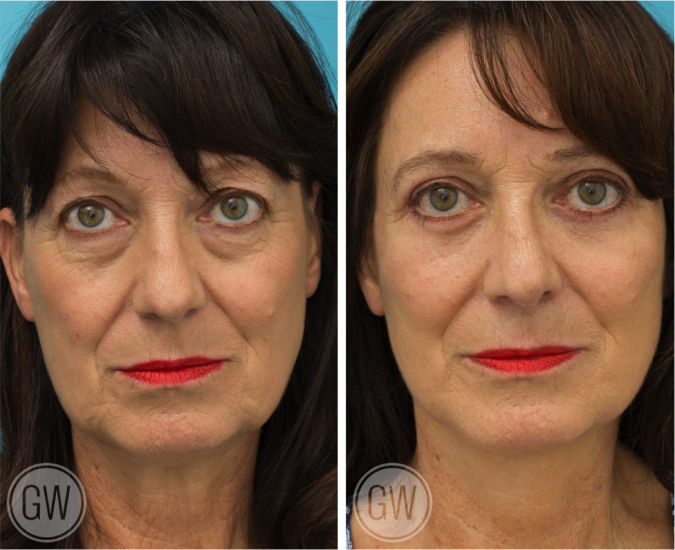
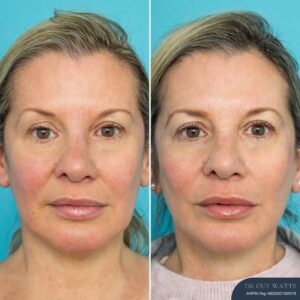
Photo disclaimer:
Each surgical procedure produces unique outcomes influenced by factors such as body composition, skin tone, laxity, age, and genetics. The before-and-after photographs displayed are of actual patients and are provided for informational purposes only.
What Are Patients Asking About Recovery?
Patients increasingly want practical information about time away from work, swelling, bruising, scars, sleep position and assistance at home. Patients considering a facelift may also find the facelift surgery recovery guide useful when reviewing general recovery considerations. Recovery varies according to the procedure and the individual’s healing response.
Early social recovery is not the same as complete healing. Residual swelling, numbness and scar maturation may continue for months.
- When can I drive?
- How long will swelling remain?
- When can I exercise?
- What help will I need at home?
- When can I return to public-facing work?
What Risks Are Patients Asking About?
Patients commonly ask about bleeding, infection, delayed healing, scarring, asymmetry and changes in sensation. Face and neck surgery also carries a risk of injury to sensory or motor nerves.
Recent systematic reviews continue to evaluate facial nerve injury after facelift surgery and note variation in injury severity, reporting and management. This reinforces the need for a procedure-specific risk discussion rather than broad reassurance.
- Bleeding or haematoma
- Infection or wound-healing problems
- Altered sensation
- Facial nerve injury
- Further treatment or surgery
Are Patients Asking for a Particular Named Technique?
Online discussions often focus on named facelift methods. A procedure name, however, may not describe the exact dissection, ligament release or tissue repositioning used by every surgeon.
The more useful questions concern what will be done in the patient’s case, why that approach is proposed and what risks and alternatives apply.
- Which anatomical plane will be used?
- What structures will be repositioned?
- Where will the scars sit?
- What complications are relevant?
- Why is this method suitable for me?
Why Are Patients Asking About Long-Term Results?
Patients want to know how facial surgery may change over time and whether another operation will eventually be required. Surgery changes selected tissues but does not stop bone remodelling, skin ageing or changes in fat distribution. Changes in the facial retaining ligaments may also influence how facial tissues are supported over time.
The duration of an observable result depends on the operation, tissue quality, health, sun exposure and weight stability. Further surgery is possible but not inevitable.
- Ageing continues after surgery
- Skin quality remains relevant
- Weight changes can alter facial volume
- Sun exposure affects the skin
- Future treatment cannot be predicted precisely
What Should I Ask During a Facial Surgery Consultation?
Useful questions focus on the proposed operation, its limitations, alternatives and recovery rather than a promised appearance. Patients should understand the surgeon’s qualifications and the arrangements for hospital care and follow-up.
Australian Medical Board guidance requires appropriate assessment, informed consent and discussion of risks before cosmetic surgery.
- What structures are contributing to my concern?
- What can surgery realistically address?
- What scars should I expect?
- What are the material risks?
- What happens if I have a complication?
Download Dr Guy Watts’ Face and Neck Lift Surgery Guide
How Does Dr Guy Watts Assess Facial Surgery Patients?
Dr Guy Watts assesses the face and neck at rest and during movement. He reviews skin quality, facial fat, muscle activity, skeletal support, previous procedures and general health.
The purpose of consultation is to determine whether surgery is appropriate and explain the available options. A consultation does not create an obligation to proceed.
- Review medical and medication history
- Examine the face and neck together
- Discuss previous treatments
- Explain risks, scars and recovery
- Consider staged or alternative approaches
What Might Make Facial Surgery Unsuitable?
Surgery may be postponed or not recommended when medical risk is too high, nicotine use is ongoing or expectations do not align with what the procedure can achieve.
Further assessment may also be required for unmanaged eye symptoms, skin conditions, psychological concerns or previous surgery that has altered the anatomy.
- Uncontrolled health conditions
- Smoking, vaping or nicotine use
- Unrealistic expectations
- Insufficient recovery support
- Uninvestigated symptoms
Why Should Trends Not Determine My Surgical Decision?
Trends change more quickly than anatomy. A popular operation may not address the structures contributing to a patient’s concern and may expose that person to unnecessary risk.
A responsible decision should be based on individual assessment, informed consent and adequate time for consideration. The goal is not to follow a current look but to decide whether a specific operation is medically and personally appropriate.
- Popularity does not establish suitability
- Technique names can be used inconsistently
- Social media may omit complications
- Results cannot be copied between patients
- Declining surgery remains a valid decision
Why Might I Consult Dr Guy Watts About Facial Surgery?
Dr Guy Watts is a Specialist Plastic and Reconstructive Surgeon who assesses facial concerns from an anatomical and medical perspective. He provides facial surgery consultations through his Perth practice.
Choosing a surgeon should involve verifying specialist registration and discussing the exact procedure, risks, alternatives, hospital arrangements and follow-up care.
- Specialist registration in Plastic Surgery
- Fellowship of the Royal Australasian College of Surgeons
- Individual face and neck assessment
- Surgery in accredited hospitals
- Perth-based follow-up care
How Do I Arrange a Facial Surgery Consultation?
You can contact Dr Guy Watts’ Perth clinic to request an appointment. The clinic can explain current referral and consultation requirements.
Bring a medication list and details of previous facial surgery, injectable treatments, skin procedures or relevant medical conditions. Preparing written questions can help guide the appointment.
- Contact the Perth clinic
- Obtain any required referral
- Gather previous procedure information
- List medicines and supplements
- Prepare questions before attending
Take our quiz, and find out if you are ready for surgery
Medical References
- Current Trends in Facelift and Necklift Procedures / Journal of Clinical Medicine (MDPI) - https://www.mdpi.com/2077-0383/14/12/4273
- Objective Analysis of Age‑Related Changes in the Superficial Musculoaponeurotic System in Japanese Females Using Computed Tomography / Aesthetic Surgery Journal Open Forum – https://academic.oup.com/asjopenforum/article/doi/10.1093/asjof/ojad043/7170628
- Facelift Surgery and Nerve Injury: A Systematic Review and Meta‑Analysis / Aesthetic Plastic Surgery (Springer) – https://link.springer.com/article/10.1007/s00266-025-04932
Further Reading
-
- Read Dr Watt’s Blog on Facelift vs Mini Facelift: Key Differences, Limitations and Suitability
- Read Dr Watt’s Blog on Recovery after Facelift Surgery
- Read more about Facelift Surgery for Patients in Their 40s, 50s and 60s
- Read Dr Watt’s Blog on Can A Face Lift Look Natural? Understanding Today’s Techniques For Facial Balance
- Read more about Deep Plane Facelift
- Read more about Anterior Neck Lift Perth
- Read more about Deep Neck Lift Surgery Perth with Dr Guy Watts
About Dr. Guy Watts – MED0001539378
FRACS (Plas) – Specialist Plastic Surgeon In Perth WA

Dr. Guy Watts is a Specialist Plastic Surgeon (AHPRA MED0001539378) with an extensive career that spans across renowned plastic surgery clinics worldwide. His experience has been honed through invaluable experiences at esteemed establishments such as the New York Eye and Ear Infirmary and the renowned Pitanguy Clinic in Brazil.
Having collaborated with the foremost cosmetic plastic surgeons on a global scale, Dr. Watts has chosen to return to Perth after a 17-year journey of intensive training and invaluable professional experience to bring the latest practices and technology in cosmetic plastic surgery to his patients.
Dr. Watts is a Fellow of the Royal Australasian College of Surgeons (FRACS) and a Member of the Australian Society of Plastic Surgeons (ASPS), Australasian Society of Aesthetic Plastic Surgeons (ASAPS) and the International Society of Aesthetic Plastic Surgeons (ISAPS).
Read about the potential Risks and Complications of Surgery
Read the Patient Information and Resources
About CLINISPA
Clinispa is Dr Watts’ bespoke medical clinic performing Cosmetic Aesthetic treatments. At Clinispa, we offer advanced clinical treatments in a luxurious and calming environment, tailored to support your skin’s health and appearance.
Clinispa aesthetic services are performed by Dr Guy Watts’ nursing professionals, who have a passion for and solid understanding of facial aesthetics.
All Clinispa clients are considered individually, with a personalised treatment plan consisting of advanced scientific approaches to cosmetic aesthetics. We incorporate innovative technologies in conjunction with superiorly formulated skin care.
For more information about the full range of Clinispa Aesthetic of Cosmetic Treatments visit the Clinispa website
Sorry, the comment form is closed at this time.