
This website contains imagery which is only suitable for audiences 18+.


Deep Plane Facelift vs SMAS Facelift Perth

When researching facelift surgery, many patients come across two commonly discussed techniques: the deep plane facelift and the SMAS facelift. Both are surgical facelift approaches that address deeper facial tissues, but they differ in the anatomical plane used, the way tissues are released, and how the face and jawline may be treated.

For patients in Perth considering facial surgery, understanding these differences can help support a more informed consultation with Dr Guy Watts, Specialist Plastic & Reconstructive Surgeon. This page provides general information only and does not replace personalised medical advice.

Dr Guy Watts is a Specialist Plastic & Reconstructive Surgeon based in Perth, Western Australia. He holds FRACS in Plastic Surgery and works across reconstructive and aesthetic plastic surgery.
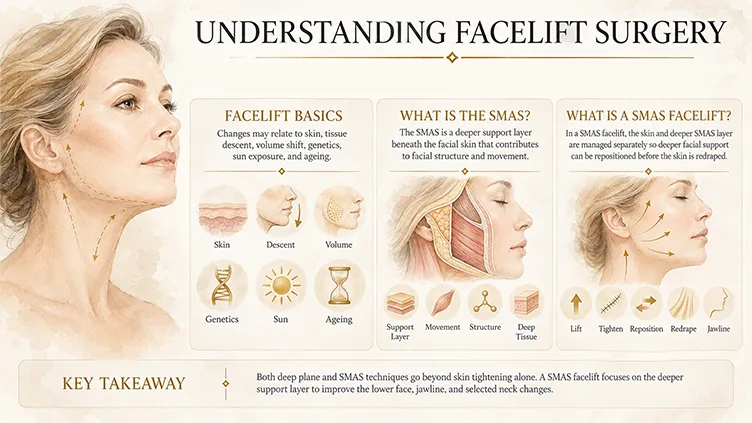
UNDERSTANDING FACELIFT SURGERY

Facelift surgery is designed to address selected age-related changes in the lower face, jawline, and sometimes the neck. These changes occur due to a combination of skin changes, tissue descent, volume redistribution, genetics, sun exposure, and natural ageing.

No facelift technique is suitable for every patient. The most appropriate approach depends on individual anatomy, skin quality, medical history, previous surgery, facial structure, and recovery considerations.

The terms “deep plane facelift” and “SMAS facelift” are often used online, but they can be confusing. Both involve more than skin tightening alone. The key difference lies in how the surgeon manages the deeper tissue layer beneath the skin.

Understanding Facelift Surgery by Dr Guy Watts

WHAT IS THE SMAS?

SMAS stands for superficial musculoaponeurotic system. It is a layer of connective tissue and muscle-like support beneath the facial skin. This layer plays an important role in facial structure and movement.

In facelift surgery, the SMAS is important because age-related tissue changes often involve more than the skin. A facelift that addresses the SMAS can reposition deeper facial support structures rather than relying only on skin tension.

Both SMAS facelift and deep plane facelift techniques involve the SMAS, but they manage it in different ways.

WHAT IS A SMAS FACELIFT?

A SMAS facelift is a surgical facelift technique that addresses the SMAS layer beneath the skin. There are several variations of SMAS facelift surgery, and the exact approach may differ between surgeons.

In many SMAS facelift techniques, the skin is lifted separately from the deeper SMAS layer. The SMAS may then be tightened, folded, lifted, repositioned, or partially removed depending on the technique used. The skin is then redraped without relying only on skin tension.

A SMAS facelift may be considered for selected patients with changes affecting the lower face, jawline, and neck. The extent of treatment depends on facial anatomy and surgical planning.

WHAT IS A DEEP PLANE FACELIFT?

A deep plane facelift is a facelift technique that works beneath the SMAS layer in a deeper anatomical plane. Instead of separating the skin extensively from the SMAS, the deeper facial tissues are released and repositioned together.

This approach involves releasing certain retaining ligaments that contribute to facial tissue descent. By working in this deeper plane, the surgeon can reposition deeper facial structures as a connected unit.

A deep plane facelift may be considered for selected patients with midface, lower face, jawline, and neck changes. The suitability of this technique depends on clinical assessment, anatomy, health, and expectations.

DEEP PLANE FACELIFT VS SMAS FACELIFT: MAIN DIFFERENCE

The main difference between a deep plane facelift and a SMAS facelift is the surgical plane used to reposition facial tissues.

A SMAS facelift usually involves lifting the skin separately and then tightening or repositioning the SMAS layer.

A deep plane facelift works beneath the SMAS and releases deeper retaining structures so the facial tissues can be repositioned in a different way.

Neither technique is automatically appropriate for every patient. Both are established facelift approaches, and both require careful surgical planning.

COMPARISON TABLE

Feature Deep Plane Facelift SMAS Facelift
Tissue layer addressed Works beneath the SMAS layer Addresses the SMAS layer
Skin separation Often involves less separation between skin and SMAS in selected areas Often involves more separation of skin from the SMAS
Tissue release Involves release of deeper retaining ligaments May involve tightening, folding, lifting, or repositioning the SMAS
Treatment focus Midface, lower face, jawline, and neck depending on plan Lower face, jawline, and neck depending on plan
Incisions Usually around the ears and hairline Usually around the ears and hairline
Anaesthesia Usually performed in hospital under anaesthesia Usually performed in hospital under anaesthesia
Recovery Swelling, bruising, tightness, numbness, and healing over time Swelling, bruising, tightness, numbness, and healing over time
Suitability Depends on anatomy and surgical assessment Depends on anatomy and surgical assessment

SIMILARITIES BETWEEN DEEP PLANE AND SMAS FACELIFT SURGERY

Although the techniques differ, they also have important similarities.

Both procedures:

  • Are surgical facelift techniques
  • Involve deeper facial tissues
  • Require incisions
  • Are usually performed in hospital under anaesthesia
  • Involve swelling, bruising, and recovery
  • Require post-operative care and follow-up
  • Carry surgical and anaesthetic risks
  • Need personalised assessment before surgery

Both techniques may be used to address selected facial changes around the lower face and jawline. Depending on the surgical plan, neck structures may also be addressed, either as part of the facelift approach or with a neck lift.

HOW THE SURGICAL APPROACH DIFFERS

In a SMAS facelift, the surgeon usually raises the skin separately before adjusting the SMAS layer. This may involve SMAS plication, imbrication, elevation, or other modifications. The goal is to support deeper tissues while allowing the skin to be redraped.

In a deep plane facelift, the dissection occurs beneath the SMAS layer. The skin and SMAS remain connected in selected areas, and deeper facial retaining structures are released. This allows the deeper soft tissues to be repositioned as a unit.

These are technical differences. For patients, the more important question is not which technique sounds more advanced, but which approach is appropriate for their anatomy, concerns, and risk profile.

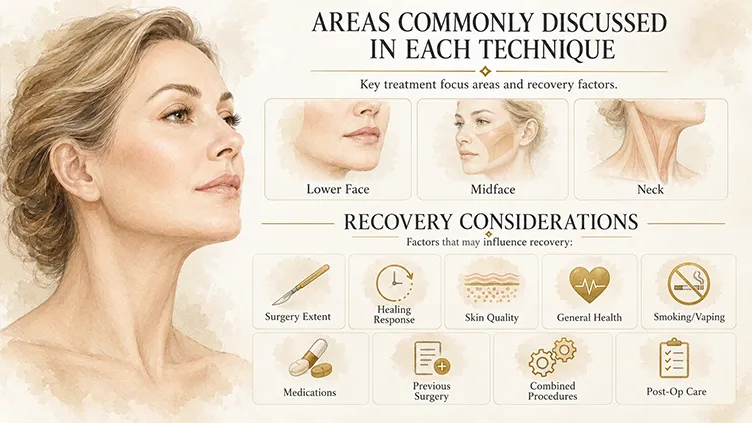
AREAS COMMONLY DISCUSSED IN EACH TECHNIQUE

✓ Lower Face and Jawline

Both SMAS and deep plane facelift techniques may be used to address selected changes around the lower face and jawline. The degree of change that can be addressed depends on tissue quality, facial structure, skin redundancy, and the surgical plan.

✓ Midface

A deep plane facelift is often discussed in relation to deeper midface tissue repositioning. Some SMAS techniques may also address the midface, depending on the surgeon’s approach.

✓ Neck

Neck concerns may require separate planning. Some facelift techniques include neck work, while other patients may need a neck lift as a separate or combined procedure. Dr Guy Watts will assess the face and neck together to determine what is suitable.

Areas Commonly Discussed In Each Technique by Dr Guy Watts

RECOVERY CONSIDERATIONS

Recovery after either a deep plane facelift or SMAS facelift varies between patients. The recovery process may involve swelling, bruising, tightness, numbness, fatigue, and temporary changes in facial sensation.

Factors that influence recovery include:

  • Extent of surgery
  • Individual healing response
  • Skin quality
  • General health
  • Smoking or vaping
  • Medications
  • Previous surgery
  • Whether a neck lift or eyelid surgery is performed
  • Following post-operative instructions

Neither procedure should be described as having a guaranteed recovery experience. Some patients heal more quickly than others, and visible swelling or bruising may take longer to settle in some individuals.

Dr Guy Watts provides individualised post-operative instructions and follow-up care for patients undergoing facelift surgery in Perth.

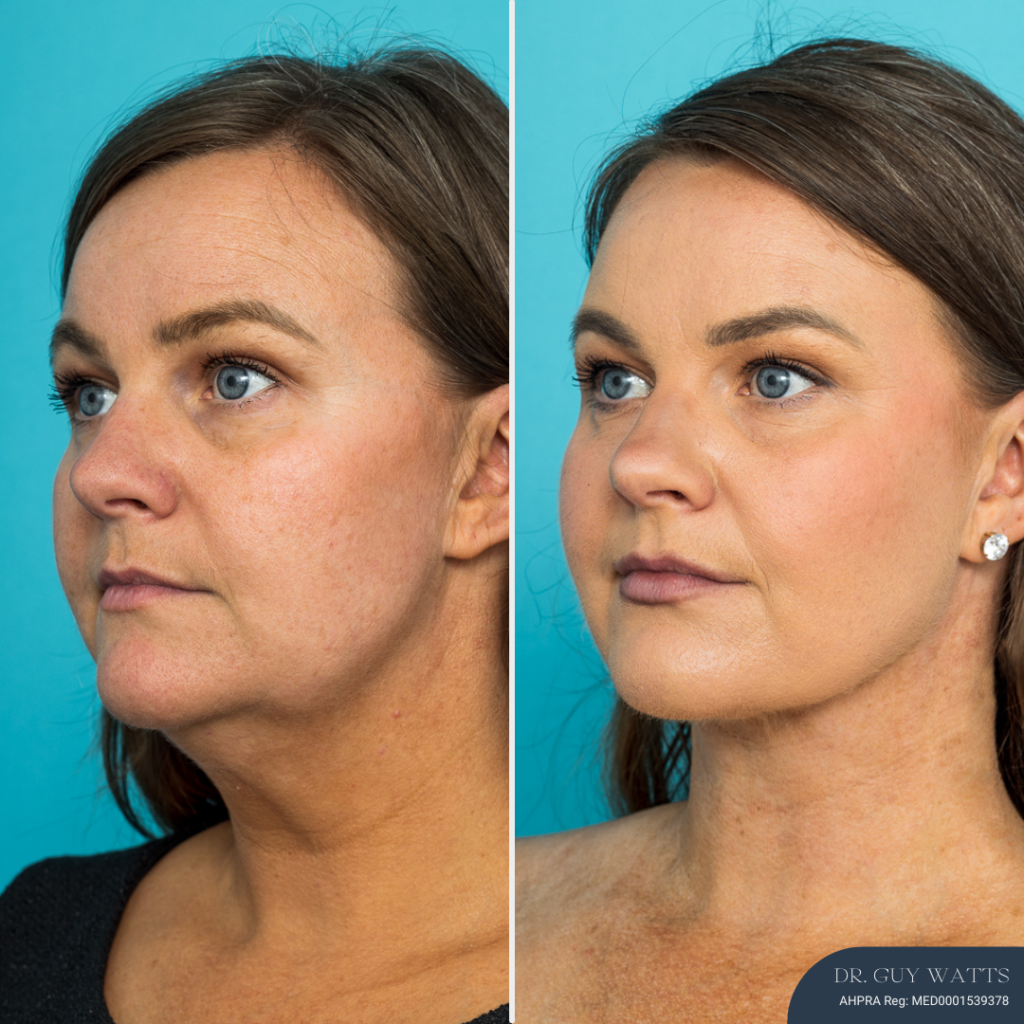
DEEP NECK LIFT BEFORE-AND-AFTER PHOTOGRAPHS

SCARRING CONSIDERATIONS

Both deep plane and SMAS facelift surgery involve incisions, commonly placed around the ears and hairline. The exact incision pattern depends on facial anatomy, hairline, skin quality, neck anatomy, and the surgical plan.

Scars are a normal part of surgery. Scar appearance varies between patients and may be influenced by genetics, skin type, smoking or vaping, sun exposure, wound healing, and post-operative care.

Scar management may include:

  • Sun protection
  • Silicone therapy, if recommended
  • Avoiding tension on healing incisions
  • Scar massage only when advised
  • Attending follow-up appointments

Patients should follow Dr Guy Watts’ advice about scar care rather than starting products or treatments independently.

RISKS AND POSSIBLE COMPLICATIONS

All surgery carries risks. Both deep plane facelift and SMAS facelift surgery have possible complications, and these must be discussed before surgery.

Possible risks may include:

  • Bleeding
  • Haematoma
  • Infection
  • Delayed wound healing
  • Fluid collection
  • Scarring concerns
  • Temporary numbness
  • Changes in facial sensation
  • Temporary or longer-lasting changes in facial movement
  • Asymmetry
  • Skin healing issues
  • Hair thinning near incision sites
  • Ongoing discomfort
  • Need for additional treatment in selected cases

The risk profile may differ depending on the technique, the extent of surgery, the surgeon’s assessment, and individual patient factors. A 2025 systematic review comparing deep plane and SMAS facelift techniques found that both approaches were associated with high patient satisfaction, while also noting reported complication rates and the need for continued evidence-based comparison.

IS A DEEP PLANE FACELIFT BETTER THAN A SMAS FACELIFT?

It is not accurate to say that one facelift technique is universally better than the other. Both deep plane facelift and SMAS facelift techniques are used in facial surgery, and both may be appropriate in selected patients.

The more appropriate question is:

Which technique is suitable for this patient’s anatomy, goals, health, and recovery considerations?

AHPRA and the Medical Board of Australia require cosmetic surgery advertising to be responsible, balanced, and not misleading. For this reason, patients should be cautious about online claims that describe one technique as always superior or suitable for everyone.

WHO MAY BE SUITABLE FOR A DEEP PLANE FACELIFT?

A deep plane facelift may be considered for selected patients with age-related changes involving deeper facial tissues, the midface, lower face, jawline, and neck.

Suitability depends on:

  • Facial anatomy
  • Skin quality
  • Tissue mobility
  • Neck anatomy
  • Medical history
  • Previous facial surgery
  • Smoking or vaping history
  • Recovery expectations
  • Willingness to follow post-operative instructions

A consultation is required to determine whether this approach is appropriate.

WHO MAY BE SUITABLE FOR A SMAS FACELIFT?

A SMAS facelift may be considered for selected patients with changes in the lower face, jawline, and neck, depending on the technique used.

Suitability depends on the same key factors:

  • Skin quality
  • Facial structure
  • Degree of tissue descent
  • General health
  • Previous surgery
  • Healing factors
  • Individual goals
  • Surgical risk profile

Some patients may be suitable for a SMAS approach, while others may be better suited to a different facelift technique or a different procedure altogether.

CAN A FACELIFT BE COMBINED WITH OTHER PROCEDURES?

In selected patients, facelift surgery may be combined with other facial procedures. This depends on anatomy, health, concerns, recovery planning, and surgical judgement.

Procedures sometimes discussed with facelift surgery include:

Combining procedures may affect recovery, risks, hospital stay, and post-operative care. Dr Guy Watts will discuss whether combined surgery is appropriate during consultation.

DEEP PLANE FACELIFT VS SMAS FACELIFT FOR MEN

Men may be suitable for either technique depending on their anatomy. Surgical planning for men may require specific consideration of beard-bearing skin, hairline position, skin thickness, facial structure, and scar placement.

The choice between a deep plane facelift and SMAS facelift should be based on clinical assessment rather than gender alone.

DEEP PLANE FACELIFT VS SMAS FACELIFT FOR WOMEN

Women may also be suitable for either technique depending on anatomy, skin quality, facial structure, and surgical goals. Some women may have concerns involving the jawline, midface, neck, or facial tissue descent.

Dr Guy Watts assesses each patient individually and explains which options may be suitable.

HOW TO DECIDE WHICH FACELIFT TECHNIQUE IS RIGHT FOR YOU

Deciding between deep plane facelift and SMAS facelift surgery requires a consultation. Online information can help patients understand terminology, but it cannot determine suitability.

During consultation, Dr Guy Watts may assess:

  • Facial proportions
  • Skin quality
  • Tissue mobility
  • Jawline and neck anatomy
  • Previous surgery
  • Medical history
  • Medications
  • Smoking or vaping
  • Recovery requirements
  • Expectations and concerns

Patients should be given time to consider information about risks, benefits, limitations, and alternatives before making a decision.

Download Dr Watts’ Guide to Face and Neck Lift

Ultimate Guide To Face and Neck Lift

WHY PERSONALISED ADVICE MATTERS

Facelift surgery is not a standardised procedure. Two patients may request the same operation but require different surgical plans because of differences in anatomy, skin quality, and healing factors.

A personalised consultation helps determine:

  • Whether surgery is appropriate
  • Which technique may be suitable
  • Whether another procedure should be considered
  • What recovery may involve
  • What risks apply to the individual
  • What limitations should be understood

Dr Guy Watts provides consultations in Perth for patients considering facial surgery and discusses procedure options in the context of individual anatomy and safety considerations.

ABOUT DR GUY WATTS

Dr Guy Watts (MED0001539378) is a Perth-based Specialist Plastic Surgeon with specialist registration in Surgery in the specialty field of Plastic Surgery. A Fellow of the Royal Australasian College of Surgeons (FRACS), he completed 17 years of surgical education, training and experience across seven countries. His international training included New York Eye and Ear Infirmary, the Hospital for Sick Children in Toronto and the Ivo Pitanguy Clinic in Brazil, with further training undertaken across Australia, North America and Europe. This combination of specialist qualifications and international training informs his individualised approach to surgical assessment, planning and patient care.

Patients considering deep plane facelift or SMAS facelift surgery can arrange a consultation to discuss suitability, risks, recovery, and treatment planning.

BOOK A CONSULTATION

If you are considering facelift surgery in Perth, a consultation with Dr Guy Watts can help clarify whether a deep plane facelift, SMAS facelift, neck lift, or another approach may be appropriate.

GW Face Procedure FAQ Image - Guy Watts

FAQS ABOUT DEEP PLANE FACELIFT VS SMAS FACELIFT

What is the main difference between a deep plane facelift and a SMAS facelift?

The primary difference is the surgical plane used to reposition the facial tissues. A SMAS facelift focuses on adjusting the superficial musculoaponeurotic system (SMAS), a layer beneath the skin that contributes to facial support. A deep plane facelift involves working beneath the SMAS layer and releasing selected retaining ligaments so that the skin and deeper tissues can be repositioned together. Both techniques address age-related facial changes, but the most appropriate approach depends on a patient’s anatomy, skin quality, and individual surgical plan.

Is a deep plane facelift better than a SMAS facelift?

Neither technique is considered universally better. Both are established facelift procedures used by Specialist Plastic & Reconstructive Surgeons to address age-related facial changes. The most appropriate technique depends on factors such as facial anatomy, the areas being treated, previous surgery, skin quality, general health, and the outcome discussed during consultation. Dr Guy Watts will assess these factors before recommending a treatment plan tailored to the individual patient.

Who may be a suitable candidate for a deep plane facelift compared with a SMAS facelift?

Suitability is determined during a comprehensive consultation rather than by age alone. A deep plane facelift may be considered for patients with changes involving the midface, lower face, jawline, or neck, while a SMAS facelift may also be appropriate for selected patients depending on their facial anatomy and the degree of tissue descent. Dr Guy Watts will assess your facial structure, medical history, skin quality, lifestyle factors, and recovery considerations before discussing which surgical approach may be suitable.

Does recovery differ between a deep plane facelift and a SMAS facelift?

Recovery varies between individuals regardless of the facelift technique performed. Both procedures involve swelling, bruising, temporary discomfort, and a gradual healing process over several months. Factors such as the extent of surgery, individual healing characteristics, smoking or vaping, overall health, and adherence to post-operative instructions can all influence recovery. Dr Guy Watts provides personalised recovery advice and regular follow-up appointments to monitor healing after surgery.

Can a deep plane facelift or SMAS facelift be combined with other facial procedures?

Yes, in selected patients either procedure may be combined with other facial surgeries if appropriate. Commonly discussed combinations include a neck lift, upper or lower eyelid surgery (blepharoplasty), brow lift, or facial fat grafting. Whether procedures are combined depends on individual anatomy, general health, surgical goals, anaesthetic considerations, and recovery planning. These options are discussed during consultation if relevant.

Will both procedures leave scars?

Yes. All facelift surgery involves incisions and therefore results in scars. For both deep plane facelift and SMAS facelift procedures, incisions are typically placed around the ears and may extend into the hairline, depending on the surgical plan. Scar appearance varies between individuals and is influenced by skin type, genetics, wound healing, smoking status, and post-operative care. Dr Guy Watts will provide guidance on scar management, which may include silicone therapy, sun protection, and other measures where appropriate.

How do I know whether a deep plane facelift or a SMAS facelift is right for me?

The most appropriate way to determine which procedure may be suitable is through a consultation with Dr Guy Watts, Specialist Plastic & Reconstructive Surgeon in Perth. During your consultation, he will assess your facial anatomy, skin quality, medical history, previous surgery, and the specific changes you would like to address. He will also discuss the potential benefits, limitations, risks, recovery considerations, and alternative treatment options so you can make an informed decision based on your individual circumstances.

Medical References

TAKE OUR QUIZ, AND FIND OUT IF YOU ARE READY FOR SURGERY

FURTHER READING

Next Steps on Your Plastic Surgery Journey 

Always Do Your Research
Please read our website to learn more about your intended procedure
Do you need a Medical Referral to see Dr Guy Watts?
Yes, a GP referral is required for all patients seeking surgery with Dr Watts. We ask all patients, medical and cosmetic, to obtain a GP referral prior to their consultation that includes a detailed medical history, any medications they may be on, and their current BMI. Patients will not be able to attend a consultation without a referral and we ask that you send your referral to our reception team prior to your consultation. Please note that your Medicare Rebates for medical consults will NOT be claimable without a valid recent Medical Referral.
How to Get the Most from Your Plastic Surgery Consultation

Please arrive slightly early for your in-person consultation, this will allow for any paperwork or information we may need to collect from you prior to your consultation with Dr Guy Watts.

Dr Guy Watts encourages you to bring a friend or relative to help consider the information and discuss your options surrounding the plastic surgery procedures you are interested in.

Please be aware you may need to undress for a physical examination by Dr Guy Watts. A chaperone will be present for the examination and we suggest you wear comfortable clothing to make this easier for you at the time of consultation.

Please bring along notes and any questions you have to address during the consultation, take notes at the time of consultation and thoroughly examine all the documents provided by Dr Guy Watts on the surgical plastic surgery procedures.

Want more information before scheduling your plastic surgery consultation?

If you would like more information about pricing, medical payment plans or paying for your surgery we are happy to help

Request more information about the procedure – call or contact us

How to Book Your Consultation
You can book your initial consultation via phone or email and by paying the $350 cosmetic consultation fee in advance at the time of booking your appointment
Phone for More Information on Plastic Surgery Procedures with Dr Guy Watts

To find out more information about surgery you can reach the friendly front desk team by phone to discuss your options for your chosen plastic surgery procedure.

Contact us or call 08 9286 1600  to arrange your plastic surgeon consultation in Perth.

Please email us for more information:  admin@guywattsplasticsurgeon.com.au

PLEASE TAKE INTO CONSIDERATION

Any surgical or invasive procedure carries risks. Before proceeding, you should seek a second opinion from an appropriately qualified health practitioner.