

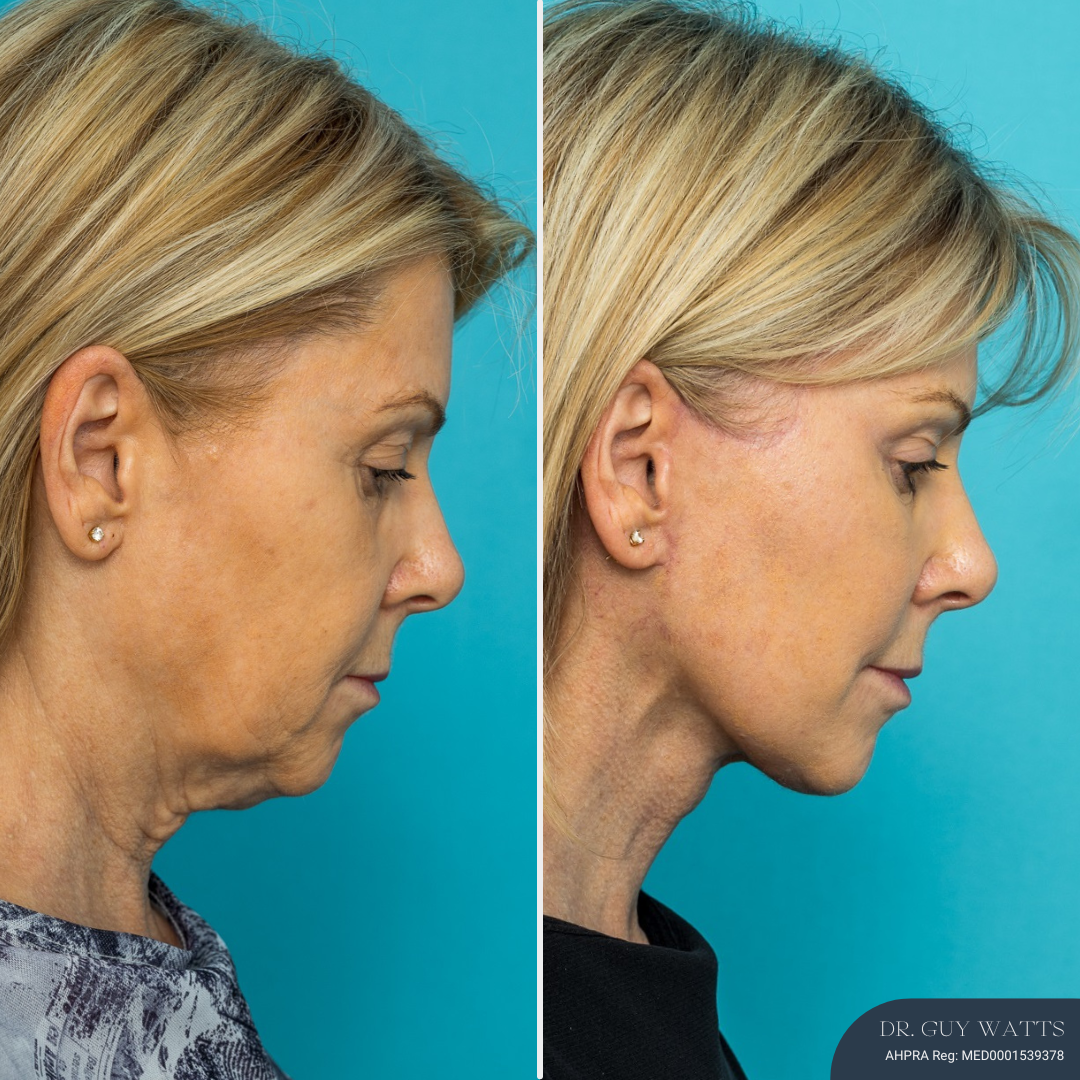
03 Mar Anterior Neck-Lift Surgery: When It’s Considered And Why
As individuals age or experience changes in body composition, the neck can undergo structural shifts that become more visible. For many women and men in Perth, this may include the appearance of vertical muscle bands, increased fullness under the chin, or changes to the definition between the jaw and neck.
An anterior neck-lift is a focused surgical procedure that may be suitable in selected cases. It addresses specific anatomical features at the front of the neck through a small incision beneath the chin. Unlike a traditional neck lift, it does not typically involve incisions behind the ears unless further skin repositioning is required.
Dr Guy Watts, Specialist Plastic & Reconstructive Surgeon in Perth, offers this procedure in circumstances where the central neck is the main area of concern. Drawing on clinical experience, surgical training and patient-centred planning, Dr Watts tailors the approach to each individual based on anatomy, medical history and personal goals.
Take our quiz, and find out if you are ready for surgery
Understanding Changes In The Neck Over Time
The neck is a structurally complex area and plays a central role in both function and appearance. Over time, several visible changes can occur in this region due to ageing, weight fluctuations, sun exposure, or genetic factors. Skin in the neck may gradually lose firmness as collagen production declines, which can lead to a change in shape or tone. A commonly seen feature involves the platysma muscle, a thin muscle that runs from the jawline to the chest. As this muscle weakens or separates, it may produce visible vertical bands, particularly during movement or speech.
Another frequently observed change is the development of increased fullness under the chin. This may be due to soft tissue accumulation, fat distribution, or muscle laxity. Additionally, the supportive structures of the neck, such as connective tissue and ligaments, can shift or lose resilience over time. These changes do not always occur uniformly, and their effect on appearance can vary widely between individuals. A comprehensive assessment is required to determine which structural elements are contributing to the changes in appearance and whether surgical options such as an anterior neck-lift may be appropriate.
What An Anterior Neck-Lift Involves
The anterior neck-lift is a procedure focused on adjusting soft tissues and muscle through a single access point at the front of the neck. It may be considered when the main concerns are limited to the area beneath the chin or along the central neck.
The key features of the procedure include:
- Access through a small incision beneath the chin
This incision allows direct access to the central neck without involving the sides of the neck unless necessary. - Adjustment of the platysma muscle
If the platysma has separated or weakened in the midline, it can be brought together with sutures to support a smoother front-of-neck appearance. - Management of soft tissue fullness
In cases where submental fat is contributing to the appearance, it may be carefully reduced or repositioned. - Support of deeper neck structures
Where indicated, ligaments and connective tissues may be adjusted to support long-term stability. - Optional skin adjustment
If skin excess is present and not expected to retract adequately, additional incisions behind the ears may be discussed and planned.
This procedure may be offered alone or in combination with other facial procedures. Suitability is determined based on individual clinical findings and surgical planning.
DOWNLOAD DR GUY WATTS’ FACE AND NECK LIFT SURGERY GUIDE
When This Procedure May Be Considered
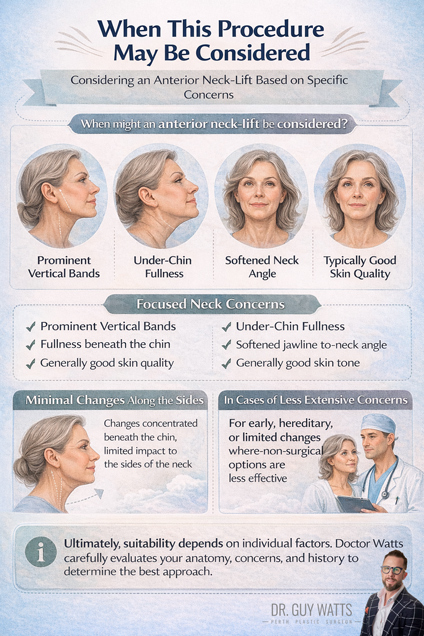
An anterior neck-lift may be discussed during consultation when there are noticeable changes limited to the front of the neck. Individuals who present with visible vertical muscle bands, particularly those that become more prominent with facial movement or speech, may be candidates for this approach. In other cases, patients report an increase in fullness under the chin, which may not respond to diet or exercise. If this fullness is accompanied by good skin tone and muscle separation, the anterior approach may be appropriate.
Some people also experience a softer or less defined angle between the jawline and neck. If these changes are concentrated beneath the chin and the sides of the neck remain relatively unaffected, an anterior neck-lift may allow access to the underlying structures without the need for more extensive procedures. In younger patients, or those with early or hereditary changes, this approach may be considered if non-surgical treatments have not addressed the concerns.
Ultimately, suitability depends on the individual’s anatomy, the nature of the changes, and the goals discussed during consultation. Not all cases of neck change require surgery, and some patients may be better suited to alternative procedures or non-surgical options.
What Happens During A Consultation With Dr Guy Watts
The first step for any individual considering surgery is a thorough consultation. At his Perth-based practice, Dr Guy Watts conducts a detailed review of each patient’s medical background, lifestyle factors, and anatomical characteristics. The consultation includes a physical examination of the neck to assess muscle tone, skin behaviour, and soft tissue distribution. Photographic documentation may also be taken for planning purposes.
Dr Watts discusses the individual’s concerns in detail and explores what they hope to address through surgery. He then explains whether the anterior neck-lift is a suitable approach based on clinical findings, or whether alternative procedures may offer a better outcome. Risks, expected recovery, and potential outcomes are all explained clearly. Patients are encouraged to ask questions and are given time to consider their options.
This consultation process is designed to guide informed decision-making and to determine the most appropriate path forward, whether surgical or non-surgical.
Surgical Steps In Anterior Neck-Lift
The anterior neck-lift is usually performed under general anaesthesia in a licensed day surgery or hospital setting.
The procedure involves the following steps:
- Placement of a central incision
This is made in the natural crease beneath the chin to access the relevant structures. - Identification and adjustment of the platysma
If the muscle has separated or weakened, it is brought together along the midline with fine sutures. - Removal or repositioning of soft tissue
Fat or redundant tissue in the submental space may be managed during the same procedure. - Support of deep tissues
Where necessary, the deep neck support structures may be modified to encourage longer-lasting results. - Skin consideration
If skin retraction is expected to be limited, additional incisions behind the ears may be used to adjust skin position. This is determined in advance.
Surgical planning is personalised. The steps above may vary slightly depending on individual needs and anatomy.
Neck Lift Surgery Before and After Photos
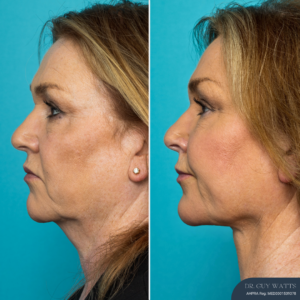
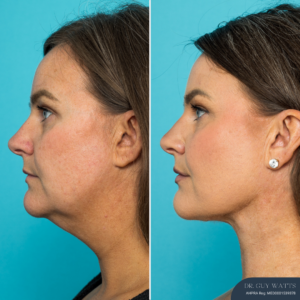
Photo disclaimer:
Each surgical procedure produces unique outcomes influenced by factors such as body composition, skin tone, laxity, age, and genetics. The before-and-after photographs displayed are of actual patients and are provided for informational purposes only.
Recovery Following Surgery
The recovery process varies between individuals. Dr Watts provides detailed aftercare instructions and monitors each patient closely through follow-up appointments.
Recovery typically includes:
- First few days
Swelling, tightness and mild discomfort are common. A support garment may be worn under the chin. Rest and limited movement are encouraged. - Week one to two
Bruising and swelling usually begin to improve. Most individuals resume non-physical activities during this time. Follow-up appointments are scheduled to assess progress. - Ongoing recovery
Final adjustments to tissue and incision healing may continue for several months. Scar appearance tends to improve over time and is supported by post-operative care advice.
Patients are advised to avoid strenuous exercise, sun exposure to the incision site, and unapproved skincare products during the healing period.
Long-Term Considerations
An anterior neck-lift addresses visible structural changes that have already developed. It does not prevent future change but may support an improved appearance in the central neck for many years.
Long-term results depend on:
- Natural tissue ageing
The neck may continue to change over time, although the adjusted structures can support more gradual transitions. - Lifestyle and sun protection
Avoiding sun exposure, maintaining a balanced weight, and adopting healthy habits may contribute to lasting results. - Post-operative care
Following all aftercare instructions and attending regular reviews supports steady recovery and long-term outcomes.
Dr Watts discusses these factors during consultation and follow-up to ensure patients have a clear understanding of what the procedure involves.
Suitability For Anterior Neck-Lift
Individuals may be considered for this procedure if they:
- Have visible central neck changes such as muscle bands or soft tissue fullness
- Are in good general health and understand the recovery requirements
- Do not have significant skin laxity that would require a full neck lift
- Have realistic expectations based on clinical evaluation
- Are seeking a surgical option after careful consideration of non-surgical treatments
Surgical recommendations are made only after a full clinical assessment. Dr Watts provides clear, honest advice and supports patients through the decision-making process.
Anterior Neck-Lift Surgery FAQs
Arranging A Consultation
Those considering anterior neck-lift surgery can book a consultation with Dr Guy Watts, Specialist Plastic & Reconstructive Surgeon in Perth, WA. During this appointment, Dr Watts will conduct a detailed assessment, discuss the individual’s goals, and outline whether the procedure is suitable based on clinical findings.
The consultation includes a physical examination of the neck, a review of medical history, and a discussion of surgical and non-surgical options. Patients are encouraged to ask questions and take time to consider their choices.
To arrange an appointment, contact Dr Watts’ practice for further information. The team will provide guidance on what to expect before, during, and after your consultation.
Further Reading
- Read more about Face Lift
- Read more about Facial Augmentation
- Read more about Chin Augmentation – Genioplasty
- Read Dr Guy Watts’ Blog on Recovery After A Deep Neck Lift
- Read Dr Guy Watts’ Blog on Heavy Neck – Causes and Options
- Read Dr Guy Watts’ Blog on What Is Chin Ptosis? – Options for Double Chin Treatment
- Read Dr Guy Watts’ Blog on Why You Should Not Remove The Salivary Gland During A Neck Lift
About Dr. Guy Watts – MED0001539378
FRACS (Plas) – Specialist Plastic Surgeon In Perth WA

Dr. Guy Watts is a Specialist Plastic Surgeon (AHPRA MED0001539378) with an extensive career that spans across renowned plastic surgery clinics worldwide. His experience has been honed through invaluable experiences at esteemed establishments such as the New York Eye and Ear Infirmary and the renowned Pitanguy Clinic in Brazil.
Having collaborated with the foremost cosmetic plastic surgeons on a global scale, Dr. Watts has chosen to return to Perth after a 17-year journey of intensive training and invaluable professional experience to bring the latest practices and technology in cosmetic plastic surgery to his patients.
Dr. Watts is a Fellow of the Royal Australasian College of Surgeons (FRACS) and a Member of the Australian Society of Plastic Surgeons (ASPS), Australasian Society of Aesthetic Plastic Surgeons (ASAPS) and the International Society of Aesthetic Plastic Surgeons (ISAPS).
Read about the potential Risks and Complications of Surgery
Read the Patient Information and Resources
About CLINISPA
Clinispa is Dr Watts’ bespoke medical clinic performing Cosmetic Aesthetic treatments. At Clinispa, we offer advanced clinical treatments in a luxurious and calming environment, tailored to support your skin’s health and appearance.
Clinispa aesthetic services are performed by Dr Guy Watts’ nursing professionals, who have a passion for and solid understanding of facial aesthetics.
All Clinispa clients are considered individually, with a personalised treatment plan consisting of advanced scientific approaches to cosmetic aesthetics. We incorporate innovative technologies in conjunction with superiorly formulated skin care.
For more information about the full range of Clinispa Aesthetic of Cosmetic Treatments visit the Clinispa website
Sorry, the comment form is closed at this time.