

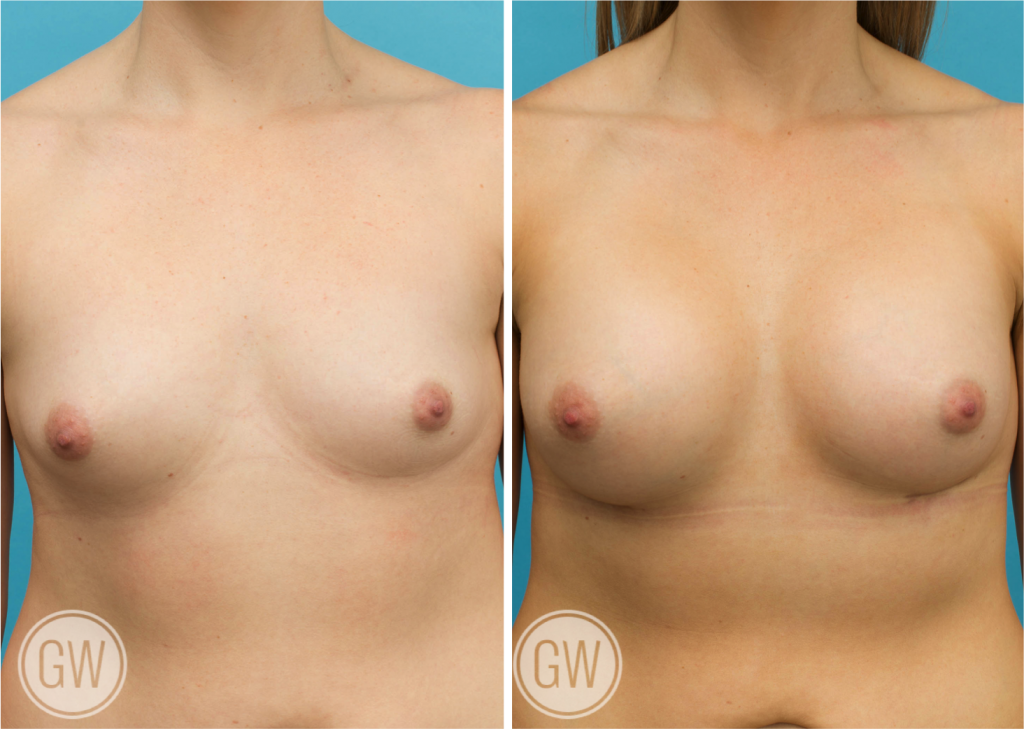
20 Dec Hybrid Breast Augmentation: Who’s It For and What Are the Benefits?
Choosing to undergo breast augmentation is a personal decision shaped by a variety of factors. These may include body proportions, lifestyle, prior surgical history and aesthetic goals. For some individuals, achieving a tailored result means going beyond implants alone. Hybrid breast augmentation is a surgical technique that combines traditional implants with autologous fat transfer. It may be considered an alternative when standalone methods do not align with a patient’s preferences or anatomy.
Dr Guy Watts, Specialist Plastic & Reconstructive Surgeon based in Perth, offers this procedure to patients seeking both volume enhancement and contour refinement. Through a considered and individualised approach, Dr Watts helps patients explore outcomes that align with their anatomy and expectations.
Take our quiz, and find out if you are ready for surgery
Understanding Hybrid Breast Augmentation
Hybrid breast augmentation, also known as composite breast augmentation, is a dual-technique procedure that merges the structure of an implant with reshaping using a patient’s own fat.
Implants provide volume, shape and projection, particularly in the lower breast pole. Fat transfer, typically harvested from areas such as the flanks, abdomen or thighs, is used to fine-tune contours and create a smoother transition between the implant and natural breast tissue.
This approach allows Dr Watts to address specific challenges such as visible implant edges, asymmetry or limited volume in areas such as the upper pole or cleavage region. The outcome is a more integrated adjustment that leverages the advantages of both techniques.
Why Patients in Perth Are Considering Hybrid Techniques
At his West Perth clinic, Dr Guy Watts regularly consults with women seeking refined solutions to breast enhancement. Hybrid breast augmentation is a technique often considered by individuals who want more than what implants or fat grafting alone can achieve.
Common reasons patients express interest include:
- Subtle refinement. Some prefer a softer feel and appearance without significantly increasing breast size.
- Customisation. The technique allows targeted placement of volume in specific areas of the breast.
- Revision surgery. Patients addressing rippling or visible implant edges may benefit from the smoothing effect of fat grafting.
- Post-pregnancy changes. Hybrid techniques may assist with volume restoration after weight fluctuations or breastfeeding, particularly when the upper breast has reduced in fullness over time.
Perth’s population includes women of diverse ages and needs. Hybrid breast augmentation offers an individualised option within Dr Watts’ practice.
DOWNLOAD DR WATTS’ GUIDE TO COST OF SURGERY
Who Might Be Suitable for Hybrid Breast Augmentation?
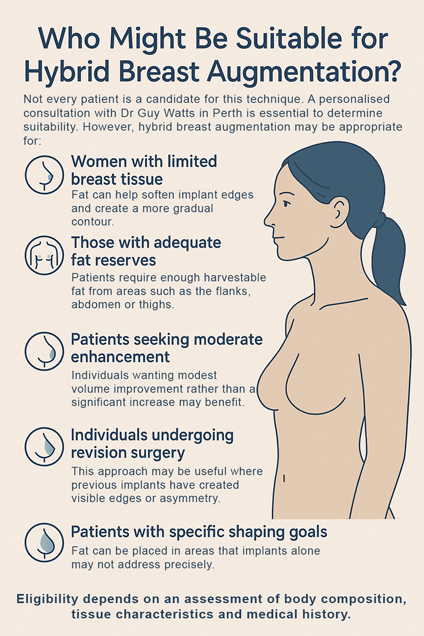
Not every patient is a candidate for this technique. A personalised consultation with Dr Guy Watts in Perth is essential to determine suitability. However, hybrid breast augmentation may be appropriate for:
- Women with limited breast tissue. Fat can help soften implant edges and create a more gradual contour.
- Those with adequate fat reserves. Patients require enough harvestable fat from areas such as the flanks, abdomen or thighs.
- Patients seeking moderate enhancement. Individuals wanting modest volume improvement rather than a significant increase may benefit.
- Individuals undergoing revision surgery. This approach may be useful where previous implants have created visible edges or asymmetry.
- Patients with specific shaping goals. Fat can be placed in areas that implants alone may not address precisely.
Eligibility depends on an assessment of body composition, tissue characteristics and medical history.
What Happens During the Procedure?
Hybrid breast augmentation is performed under general anaesthetic in an accredited hospital. The procedure typically involves two key stages:
Fat harvesting and preparation
Liposuction is used to collect fat from donor sites such as the abdomen, thighs or flanks. The fat is then purified to remove excess fluid, oil and non-viable cells.
Implant placement and fat transfer
Breast implants are inserted using a technique suited to the patient’s anatomy, often through an inframammary incision. Placement may be under the pectoral muscle (submuscular) or partly under the muscle (dual-plane). Once the implants are positioned, the prepared fat is strategically injected into areas such as the upper pole, cleavage region or lateral breast to refine shape and improve symmetry.
Hybrid augmentation generally takes longer than standard augmentation due to the added liposuction and fat grafting steps. Dr Watts performs each phase with careful attention to anatomical proportions to support a balanced result, though individual outcomes vary.
Breast Augmentation Before and After Photos
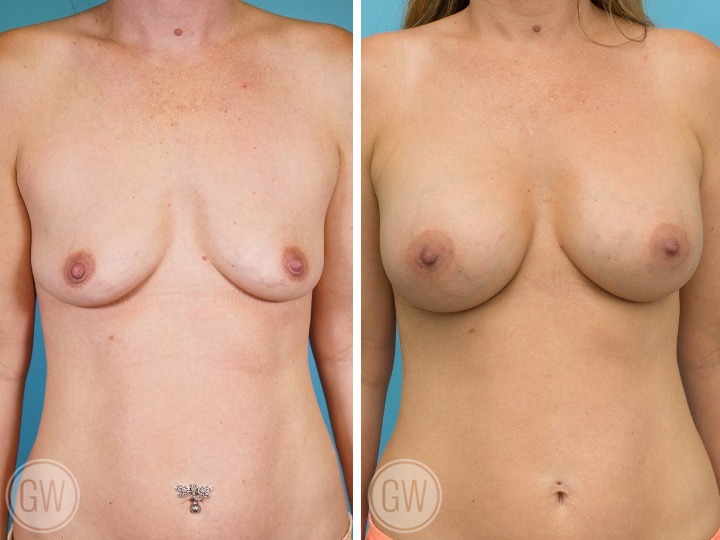
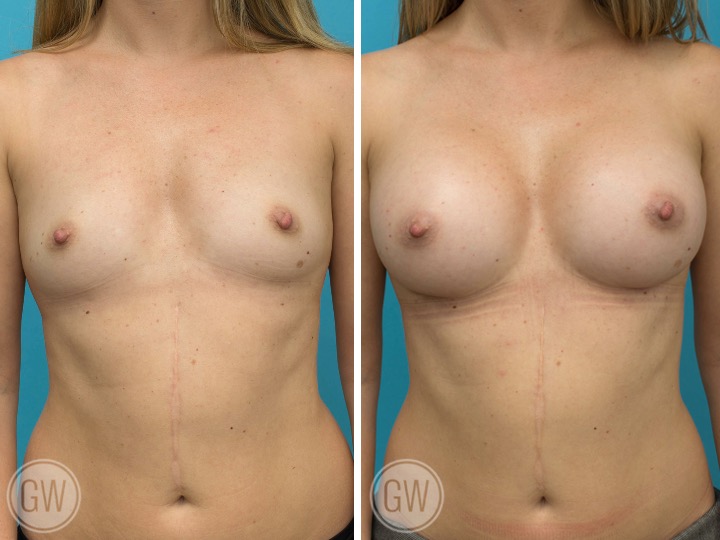
Photo disclaimer:
Each surgical procedure produces unique outcomes influenced by factors such as body composition, skin tone, laxity, age, and genetics. The before-and-after photographs displayed are of actual patients and are provided for informational purposes only.
The Recovery Process After Hybrid Breast Augmentation
Recovery involves healing at both the breast and fat donor areas. Swelling, bruising and mild discomfort are common.
Dr Watts provides a detailed post-operative plan tailored to each patient. In general, the recovery may include:
- Week 1: Swelling and tightness in the chest and donor areas. Compression garments are typically worn over liposuction sites. Most patients rest at home and limit upper body movement.
- Weeks 2 to 3: Many return to non-strenuous work and light daily activities. Swelling gradually decreases.
- Weeks 4 to 6: Gradual reintroduction of physical activity with guidance from Dr Watts.
- Months 3 to 6: Ongoing settling of breast shape, scar maturation and fat graft retention.
A portion of the transferred fat, typically 30 to 50 percent, may be reabsorbed by the body. This is anticipated and accounted for during the procedure. Further adjustments can be discussed during follow-up consultations.
Potential Benefits of Hybrid Breast Augmentation
Potential benefits may include:
- Customised shape and projection. Implants provide reliable volume, while fat allows subtle shaping.
- Improved implant blending. Fat grafting can reduce the visibility of implant edges in patients with thin tissue coverage.
- Enhancement of targeted areas. Fat can be placed precisely to address upper pole or cleavage regions.
- Refinement after previous surgery. This approach may assist with smoothing irregularities or asymmetry.
- Use of your own tissue. Fat grafting utilises the patient’s own cells.
- Potential donor site changes. Some patients note volume reduction where liposuction was performed.
Actual outcomes depend on anatomy, healing and technique.
Limitations and Considerations
While hybrid breast augmentation is valuable for many patients, considerations include:
- It may not be suitable for individuals with very limited fat reserves.
- Fat resorption is expected. Additional grafting may be needed in some cases.
- Implants remain necessary for reliable projection.
- Procedure time is longer than standard augmentation.
- Scarring and bruising at donor sites may occur.
- Risks include infection, bleeding, capsular contracture, fat necrosis and asymmetry. These are discussed in-depth during consultation.
FAQs About Hybrid Breast Augmentation
Why a Personalised Approach Matters
Hybrid breast augmentation is not a one-size-fits-all procedure. It requires thoughtful planning and technical precision to balance implant volume with targeted fat transfer. Each step of the process, from surgical technique to fat harvesting and placement, must be adapted to the patient’s unique anatomy and goals.
Dr Guy Watts, Specialist Plastic & Reconstructive Surgeon in Perth, takes a comprehensive approach to patient assessment. During consultation, factors such as tissue elasticity, breast dimensions, fat distribution and overall health are carefully reviewed. This assessment helps determine whether hybrid augmentation is appropriate and, if so, how to tailor the procedure for proportionality and balance.
The personalised nature of hybrid augmentation is important because even subtle differences in fat volume and placement can influence the final contour. Dr Watts’ planning process focuses on anatomical compatibility and long-term stability while ensuring that patients are fully informed about every stage of treatment and recovery.
This approach helps patients make decisions based on clarity and realistic expectations.
The Role of Imaging and Pre-Operative Planning
Pre-operative planning plays a critical role in hybrid breast augmentation. At Dr Watts’ West Perth clinic, clinical photography and imaging tools may be used to document baseline anatomy and guide surgical planning. These tools help establish a shared understanding of what changes may be achievable and what limitations might exist.
Volume measurements, tissue thickness assessments and donor site evaluations support accurate and safe planning. For example, if fat is to be taken from the abdomen or thighs, the quality and quantity of harvestable fat must be evaluated.
Implant selection also forms part of this planning phase. Base width, projection and implant type are considered alongside the intended fat grafting zones. This helps ensure consistency between patient goals and surgical feasibility.
A well-structured planning process helps patients understand their options and prepares them for realistic outcomes.
Is Hybrid Augmentation Right for You?
Hybrid breast augmentation may be suitable for individuals seeking refined volume enhancement or addressing previous surgical concerns. However, it is not appropriate for everyone. Suitability depends on a combination of anatomical factors, fat availability, medical history and personal goals.
This approach may benefit those with limited tissue coverage, moderate enhancement objectives or shaping goals that implants alone cannot meet. It can also support correction of rippling or asymmetry in revision cases.
Patients must have sufficient fat stores for harvesting. Very lean individuals may not be suitable candidates for this procedure.
To determine whether hybrid augmentation is appropriate for your needs, Dr Guy Watts offers in-person consultations at his West Perth practice. During this consultation, he will assess your anatomy, discuss available options and provide balanced, evidence-based information to support your decision.
Ready to Explore Your Options in Perth?
If you would like to explore whether hybrid techniques may be appropriate for your goals, Dr Guy Watts offers individualised consultations at his West Perth practice. These appointments provide the opportunity to discuss your concerns, review your anatomy and consider surgical options in detail.
This informed and collaborative approach supports decision-making that aligns with your expectations, medical history and lifestyle.
Contact Information
For more information or to schedule a consultation, contact:
Dr Guy Watts – Specialist Plastic & Reconstructive Surgeon
Address: 8 Ventnor Avenue, West Perth WA 6005
Phone: (08) 9286 1600
Disclaimer: This blog is for general informational purposes only and does not constitute medical advice. Individual outcomes will vary. Please consult a qualified Specialist Plastic Surgeon for personalised guidance.
Further Reading
- Read about Dr Guy Watt’s Blog on Why Dr Guy Watts Prefers Mentor Implants for Breast Procedures
- Read about Dr Guy Watt’s Blog on Different Types of Silicone Breast Implants
- Read about Dr Guy Watt’s Blog on Types of Breast Implant Incisions
- Read about Dr Guy Watt’s Blog on What Are the Most Subtle Looking Breast Implants?
About Dr. Guy Watts – MED0001539378
FRACS (Plas) – Specialist Plastic Surgeon In Perth WA

Dr. Guy Watts is a Specialist Plastic Surgeon (AHPRA MED0001539378) with an extensive career that spans across renowned plastic surgery clinics worldwide. His experience has been honed through invaluable experiences at esteemed establishments such as the New York Eye and Ear Infirmary and the renowned Pitanguy Clinic in Brazil.
Having collaborated with the foremost cosmetic plastic surgeons on a global scale, Dr. Watts has chosen to return to Perth after a 17-year journey of intensive training and invaluable professional experience to bring the latest practices and technology in cosmetic plastic surgery to his patients.
Dr. Watts is a Fellow of the Royal Australasian College of Surgeons (FRACS) and a Member of the Australian Society of Plastic Surgeons (ASPS), Australasian Society of Aesthetic Plastic Surgeons (ASAPS) and the International Society of Aesthetic Plastic Surgeons (ISAPS).
Read about the potential Risks and Complications of Surgery
Read the Patient Information and Resources
About CLINISPA
Clinispa is Dr Watts’ bespoke medical clinic performing Cosmetic Aesthetic treatments. At Clinispa, we offer advanced clinical treatments in a luxurious and calming environment, tailored to support your skin’s health and appearance.
Clinispa aesthetic services are performed by Dr Guy Watts’ nursing professionals, who have a passion for and solid understanding of facial aesthetics.
All Clinispa clients are considered individually, with a personalised treatment plan consisting of advanced scientific approaches to cosmetic aesthetics. We incorporate innovative technologies in conjunction with superiorly formulated skin care.
For more information about the full range of Clinispa Aesthetic of Cosmetic Treatments visit the Clinispa website
Sorry, the comment form is closed at this time.