

16 Dec How To Manage A Breast Lift Scar After Mastopexy For Favourable Healing
Recovering from breast lift surgery is a highly individual process, and scar care plays an important role in supporting healing. Mastopexy, also known as breast lift surgery, is a procedure that reshapes and repositions the breast without significantly altering its volume. As with all surgical procedures, incisions are necessary, and scars are a normal and expected part of the healing process. With appropriate care, scars may gradually mature and fade over time.
For women in Perth considering breast lift surgery, understanding how scars evolve and how to support your body through the recovery period is an important part of informed decision-making. Under the care of Dr Guy Watts, Specialist Plastic & Reconstructive Surgeon based in Perth, WA, patients receive structured guidance to help manage healing at each stage, including strategies to care for surgical scars.
This article explores how to manage a breast lift scar after mastopexy with a focus on long-term healing, drawing from Dr Watts’ clinical approach and evidence-informed practices.
Take our quiz, and find out if you are ready for surgery
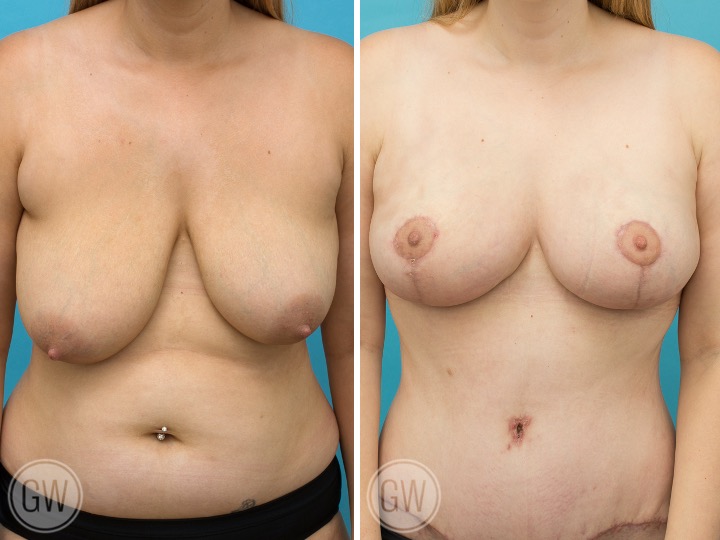
What To Expect From A Mastopexy Scar: Common Patterns And Healing Stages
Scarring is a routine outcome of procedures involving incisions. The appearance and location of mastopexy scars will depend on the surgical technique selected, which is based on factors such as skin characteristics, breast anatomy and clinical goals.
Common incision patterns include:
- Periareolar incision: A circular incision around the areola, often used for minor adjustments
- Vertical (lollipop) incision: Around the areola and vertically down to the breast fold
- Anchor (inverted-T) incision: Around the areola, vertically down, and along the natural crease beneath the breast
Each approach will leave a visible scar initially. While no scar disappears completely, many may fade and soften over time, especially with appropriate care.
Typical healing follows these stages:
- Inflammatory phase (0 to 2 weeks): Redness, swelling and firmness occur as the body begins the healing process
- Proliferative phase (2 to 6 weeks): Collagen production increases, and the scar may appear raised or darker
- Remodelling phase (6 weeks to 12 months or more): The scar gradually flattens and lightens in colour, though this process varies among individuals
Factors That May Influence How A Breast Lift Scar Heals
Healing is affected by a range of biological and environmental factors, including:
- Genetics: Some individuals are more likely to develop thicker or more prominent scars, such as hypertrophic or keloid types
- Skin tone: Darker skin tones may be more prone to pigmentation changes
- Age: Healing capacity and skin elasticity change over time
- Smoking: Tobacco use reduces blood flow and delays wound repair
- Medical conditions: Conditions such as diabetes or autoimmune disorders may influence healing
- Post-operative care: Adhering to wound care instructions significantly affects scar outcomes
Whether you’ve had a breast lift or augmentation, following expert guidance on managing your breast augmentation scar can support better long-term outcomes.
The surgical method also influences healing. Dr Guy Watts tailors each procedure with attention to incision placement and wound tension to help support favourable outcomes. His West Perth practice includes structured follow-up to monitor scar progression and provide early intervention where needed.
DOWNLOAD DR WATTS’ GUIDE TO COST OF SURGERY
Best Practices For Managing A Breast Lift Scar During Recovery
Scar care should begin early and continue beyond the immediate post-operative period. The following strategies are commonly used in Dr Watts’ practice: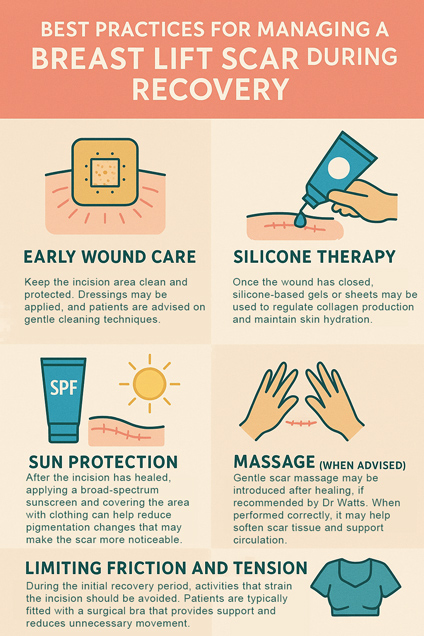
✓ Early Wound Care
In the first weeks after surgery, the priority is to keep the incision area clean and protected. Dressings may be applied, and patients are advised on gentle cleaning techniques. Preventing infection during this phase is critical to reduce complications that could affect long-term healing.
✓ Silicone Therapy
Once the wound has closed, silicone-based gels or sheets may be used to regulate collagen production and maintain skin hydration. These are typically applied daily for several weeks or months, depending on the scar’s progression. Evidence supports their role in helping to reduce scar thickness and discolouration.
✓ Sun Protection
In Perth’s high-UV environment, scar protection from sun exposure is essential. After the incision has healed, applying a broad-spectrum sunscreen and covering the area with clothing can help reduce pigmentation changes that may make the scar more noticeable.
✓ Massage (When Advised)
Gentle scar massage may be introduced after healing, if recommended by Dr Watts. When performed correctly, it may help soften scar tissue and support circulation. A qualified professional should demonstrate appropriate technique.
✓ Limiting Friction And Tension
During the initial recovery period, activities that strain the incision should be avoided. Patients are typically fitted with a surgical bra that provides support and reduces unnecessary movement. Soft, loose clothing and activity restrictions are often recommended until cleared by the surgical team.
Supporting Scar Management With Clinical Treatments
In some cases, clinical treatments may be discussed several months after surgery once the scar has stabilised. These may include:
- Laser therapy: Fractional laser treatments may help refine the texture and colour of certain scars. Timing and suitability depend on individual healing.
- Steroid injections: In the case of raised or thickened scars, corticosteroid injections may be considered to help reduce scar tissue.
- Emerging therapies: Some newer techniques, such as microneedling or light-based therapy, are currently being explored for scar modulation. These are considered on a case-by-case basis and are not routine for every patient.
All treatments are planned in consultation with Dr Watts based on clinical need and timing.
Breast Lift Surgery Before and After Photos
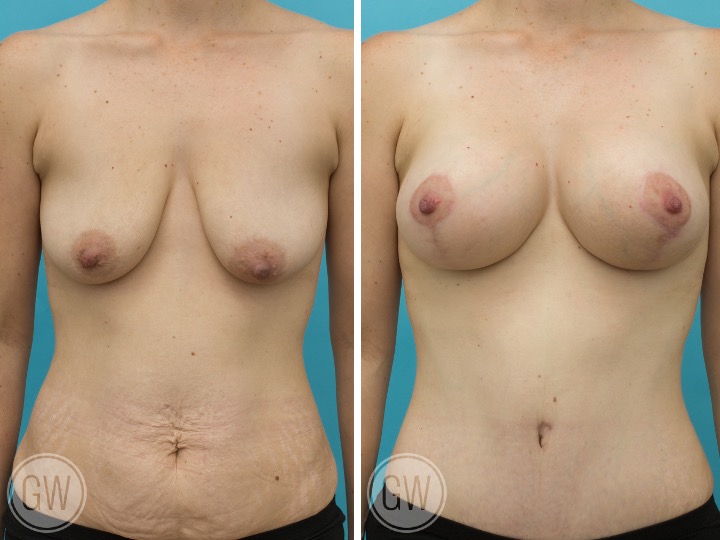
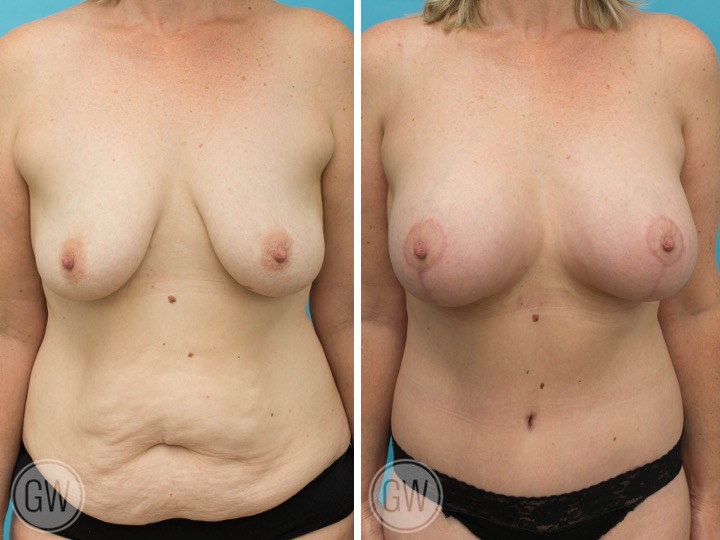
Photo disclaimer:
Each surgical procedure produces unique outcomes influenced by factors such as body composition, skin tone, laxity, age, and genetics. The before-and-after photographs displayed are of actual patients and are provided for informational purposes only.
Understanding The Psychological Impact Of Scarring
Scars are a visible reminder of surgery and can lead to varying emotional responses. While some patients adjust easily, others may feel uncertain during early recovery stages when scars appear more prominent.
It’s important to recognise that scar maturation is a long process. Dr Watts provides ongoing care to help patients understand what to expect and encourages discussion of any concerns during follow-up visits. Setting realistic expectations early supports a more informed recovery experience.
Long-Term Maintenance And Ongoing Care
Scar care should continue well beyond the early healing stages:
- Silicone therapy may continue for up to six months or more, depending on the scar’s appearance
- Ongoing sun protection remains important to prevent pigmentation changes
- Follow-up reviews are an opportunity to evaluate scar development and discuss any interventions that may be required
Improvements in scar appearance often continue for up to 12 months or longer. Maintaining consistency in care supports this process.
When To Seek Further Advice
It’s important to consult your surgeon if you experience any of the following:
- Increased redness or warmth at the scar site
- Delayed wound healing or reopening of the incision
- Thickening, itching or raised areas
- New pain or sensitivity around the scar
Dr Guy Watts and his team provide structured post-operative care and encourage patients to reach out with any concerns so that early management strategies can be implemented if needed.
FAQs About Managing A Breast Lift Scar After Mastopexy
Why Surgeon Selection Influences Scar Outcomes
Scar outcomes are influenced by surgical planning, incision technique and post-operative care. Dr Guy Watts is a fully qualified FRACS Plastic Surgeon based in Perth, WA, who uses an evidence-informed approach to surgical planning and healing support. His focused practice in reconstructive and aesthetic surgery allows for patient-specific planning, monitoring and guidance throughout the recovery period.
Scar Healing Is A Process That Takes Time
Managing a breast lift scar is an ongoing process that requires consistent care over many months. While all scars are permanent, their appearance may improve with structured management and professional guidance. Dr Guy Watts provides patients in Perth with the information and support required to navigate this journey with realistic expectations and clinical oversight.
Contact Information
For more information or to schedule a consultation, contact:
Dr Guy Watts – Specialist Plastic & Reconstructive Surgeon
Address: 8 Ventnor Avenue, West Perth WA 6005
Phone: (08) 9286 1600
Further Reading
- Read about Dr Guy Watt’s Breast Augmentation Perth Procedure Page
- Read about Dr Guy Watt’s Breast Lift with Implants (Mastopexy Augmentation) Procedure Page
- Read about Dr Guy Watt’s Blog on Surgical Options to Get Firmer Breasts
About Dr. Guy Watts – MED0001539378
FRACS (Plas) – Specialist Plastic Surgeon In Perth WA
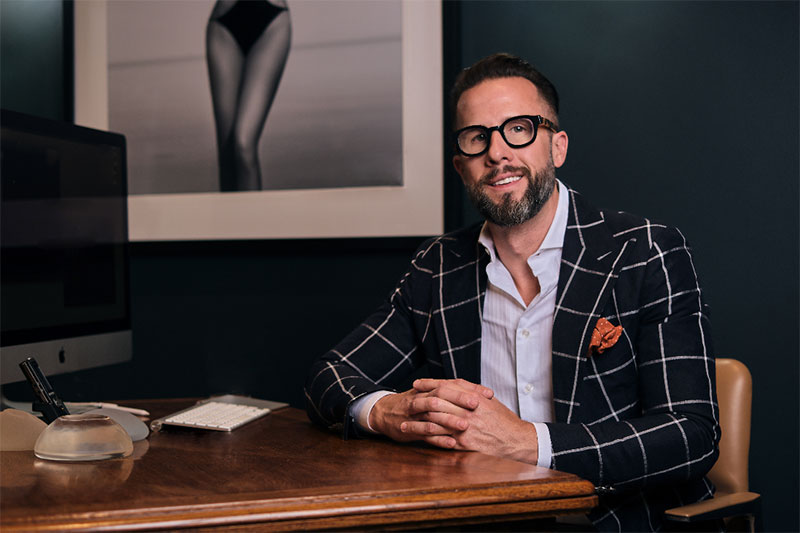
Dr. Guy Watts is a Specialist Plastic Surgeon (AHPRA MED0001539378) with an extensive career that spans across renowned plastic surgery clinics worldwide. His experience has been honed through invaluable experiences at esteemed establishments such as the New York Eye and Ear Infirmary and the renowned Pitanguy Clinic in Brazil.
Having collaborated with the foremost cosmetic plastic surgeons on a global scale, Dr. Watts has chosen to return to Perth after a 17-year journey of intensive training and invaluable professional experience to bring the latest practices and technology in cosmetic plastic surgery to his patients.
Dr. Watts is a Fellow of the Royal Australasian College of Surgeons (FRACS) and a Member of the Australian Society of Plastic Surgeons (ASPS), Australasian Society of Aesthetic Plastic Surgeons (ASAPS) and the International Society of Aesthetic Plastic Surgeons (ISAPS).
Read about the potential Risks and Complications of Surgery
Read the Patient Information and Resources
About CLINISPA
Clinispa is Dr Watts’ bespoke medical clinic performing Cosmetic Aesthetic treatments. At Clinispa, we offer advanced clinical treatments in a luxurious and calming environment, tailored to support your skin’s health and appearance.
Clinispa aesthetic services are performed by Dr Guy Watts’ nursing professionals, who have a passion for and solid understanding of facial aesthetics.
All Clinispa clients are considered individually, with a personalised treatment plan consisting of advanced scientific approaches to cosmetic aesthetics. We incorporate innovative technologies in conjunction with superiorly formulated skin care.
For more information about the full range of Clinispa Aesthetic of Cosmetic Treatments visit the Clinispa website
Sorry, the comment form is closed at this time.