Facial ageing is a gradual and multifactorial process that extends beyond changes in the skin. Many people observe shifts in their appearance over time, such as deeper lines, loss of volume in specific areas, or changes in facial shape. These are often the result of complex internal changes, including the behaviour of the facial retaining ligaments.
These ligaments are an integral part of facial anatomy. They serve as connective structures that anchor soft tissue to deeper layers and help maintain natural facial relationships. Over time, their function can change, contributing to visible signs associated with facial ageing.
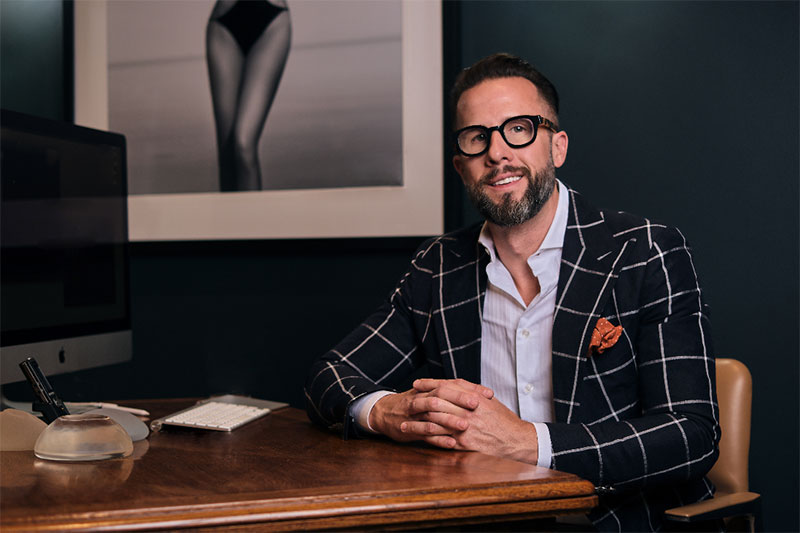
Dr Guy Watts, a Specialist Plastic & Reconstructive Surgeon in Perth, incorporates ligament-based strategies into every facelift procedure he performs. His approach is centred on structural anatomy and thoughtful surgical planning, tailored to each patient’s presentation.
In Perth and throughout Western Australia, many individuals exploring facelift surgery are seeking information about the deeper structures of the face. For those interested in surgical options, an understanding of the role of ligaments can support informed decisions and more realistic expectations.
Facelift procedures aim to support or reposition the deeper structures of the face in a way that reflects each individual’s anatomy. This involves more than adjusting surface features. A detailed understanding of the retaining ligaments plays an important role in surgical planning.
Take our quiz, and find out if you are ready for surgery
What Are Facial Retaining Ligaments?
Facial retaining ligaments are fibrous connective tissue structures that link the skin and soft tissues of the face to underlying facial layers, including fascia and bone. They function like anchoring points, maintaining the relative position of facial soft tissues and helping define key areas of the face.
These ligaments vary in density and location, depending on the region of the face. Some of the more prominent facial ligaments include:
Zygomatic ligaments, which support tissue in the cheek area
Mandibular ligaments, located near the jawline
Masseteric ligaments, which run adjacent to the masseter muscle
Orbital retaining ligaments, positioned around the eyes
When functioning optimally, these ligaments contribute to facial balance and movement by maintaining the natural positioning of overlying tissues. With time and various external or internal factors, they may change in function or tension. These changes can influence how the soft tissues of the face behave and may contribute to an altered appearance.
How Facial Ligaments Change With Age
Age-related changes in the face occur at every layer. While skin is often the most visible element, underlying tissues such as fat pads, muscle, bone and ligaments also evolve over time. Ligament laxity, or a decrease in ligament tension, can allow the soft tissue layers of the face to shift from their original positions.
For example, in the midface, changes in the zygomatic ligaments may be associated with a reduction in upper cheek fullness. In the lower face, adjustments in the mandibular ligament region may contribute to a less defined jaw area. Around the eyes, ligament-related changes may influence how tissue gathers or settles.
These shifts are not inherently problematic but may be perceived by some individuals as signs of ageing. For patients seeking surgery, understanding that such changes originate from structural repositioning rather than solely surface alterations is important. Facelift techniques that address these deeper structures can support more comprehensive and predictable outcomes.
DOWNLOAD DR GUY WATTS’ FACE AND NECK LIFT SURGERY GUIDE
Ultimate Guide To Face and Neck Lift
Why Ligament Knowledge Matters In Facelift Surgery
A contemporary facelift is not limited to lifting skin. It involves adjusting deeper layers of facial anatomy in a way that considers the patient’s individual structure. This includes a thorough understanding of the facial retaining ligaments.
In surgical practice, ligaments provide both reference points and functional elements. During a facelift, the surgeon may choose to release specific ligaments if their tension restricts the repositioning of overlying tissue. Alternatively, some ligaments may be preserved to provide support to areas that do not require adjustment.
Facial ligaments also assist in guiding the depth of surgical dissection, helping the surgeon navigate around critical structures such as nerves and blood vessels. This anatomical precision supports safety during surgery and helps avoid complications.
Dr Guy Watts integrates this level of ligament assessment into every facelift performed at his practice in Perth. His approach is not focused on aesthetic ideals, but rather on structural considerations that support the face’s existing anatomy and promote durable outcomes for suitable patients.
Surgical Techniques: Deep Plane And SMAS Facelifts
Two techniques commonly used in ligament-focused facelift surgery are the SMAS facelift and the deep plane facelift. Each technique involves repositioning deeper tissue layers to help support areas that may have shifted over time.
✓ SMAS Facelift
The superficial musculoaponeurotic system (SMAS) is a fibrous layer located beneath the skin and above the deeper facial muscles. Adjusting this layer can help address structural shifts in the cheeks and lower face. During a SMAS facelift, the surgeon may engage with nearby ligaments to allow for appropriate movement of tissue.
✓ Deep Plane Facelift
A deep plane facelift accesses tissue beneath the SMAS layer. This technique can allow for a broader repositioning of soft tissue, particularly in the midface. It involves a deeper level of dissection and closer interaction with the facial retaining ligaments.
These techniques are not interchangeable and are selected based on patient-specific anatomy. At his Perth practice, Dr Watts determines which surgical approach may be most appropriate by considering ligament function, skin characteristics, and the individual’s goals.
How Dr Guy Watts Integrates Ligament-Based Planning Into Facelift Surgery
Each facelift procedure performed by Dr Watts begins with a detailed anatomical assessment. During this process, he evaluates how the patient’s facial structure has changed over time and where ligament adaptation may be contributing to visible shifts in appearance.
This assessment guides the surgical plan. In cases where certain tissues are limited in movement due to ligament tension, targeted release may be appropriate. In other areas, preserving ligament support helps maintain natural movement and structure.
This tailored approach avoids uniform lifting. Instead, it focuses on promoting soft tissue support and facial balance in a way that reflects the patient’s existing features. By working in accordance with the individual’s anatomy, Dr Watts supports stable outcomes and encourages progressive healing.
This approach is available to patients throughout Perth and Western Australia who are considering facial surgery and seeking a measured, structural approach to managing age-related change.
Rhinoplasty And The Role Of Facial Anatomy
Rhinoplasty – also referred to as a nose reshaping procedure – is designed to adjust the internal or external structure of the nose for functional or aesthetic reasons. Although rhinoplasty is often viewed separately from facelifting, there is an important connection through midface anatomy.
Changes in facial proportions caused by shifts in ligament tension or soft tissue repositioning can influence how the nose appears. For example, when midface tissue descends over time, it can affect nasal prominence, even if the nose itself has not changed.
For this reason, patients in Perth undergoing rhinoplasty at Dr Watts’ practice are often assessed more broadly. This supports a more integrated approach to surgery and promotes facial balance. In some cases, both procedures may be planned together or at separate stages, depending on suitability and recovery planning.
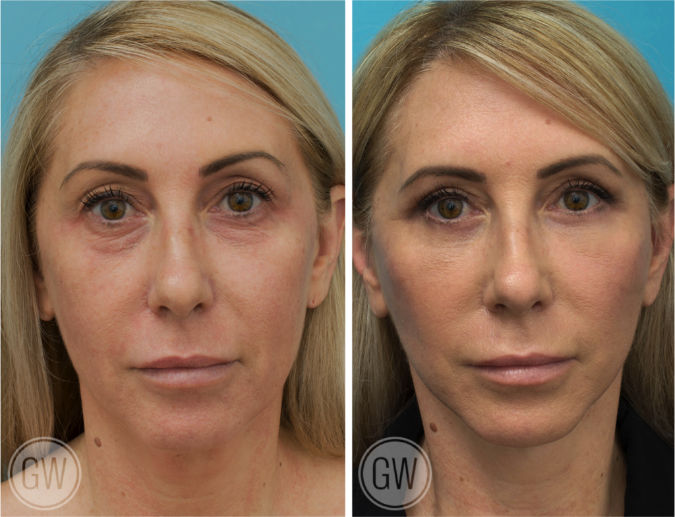
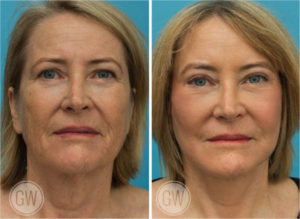
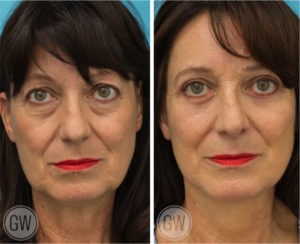
Face Lift Surgery Before and After Photos
Photo disclaimer: Each surgical procedure produces unique outcomes influenced by factors such as body composition, skin tone, laxity, age, and genetics. The before-and-after photographs displayed are of actual patients and are provided for informational purposes only.
Facial Ligaments And Gender-Inclusive Ageing Considerations
The effect of ligament adaptation on facial appearance can vary between individuals. Differences in skin thickness, bone structure, soft tissue volume, and hormonal influences can all affect how facial ageing occurs.
In women, structural changes may be more noticeable in the midface and around the mouth. In men, adjustments in the lower face and neck may become more apparent over time. These are not issues that require “correction” but may be relevant for individuals exploring surgical options.
Dr Watts provides individualised planning that takes into account each patient’s anatomy, preferences, and goals. His technique avoids assumptions about gender-related outcomes and focuses on adapting the surgical plan to the patient’s facial structure.
Local Insights: Facial Surgery Trends In Perth, WA
Patients in Perth are increasingly exploring surgical options based on anatomical understanding rather than surface-level adjustments. Many are seeking procedures that address the deeper structures associated with age-related facial change.
At Dr Watts’ practice, individuals in their 40s, 50s, and 60s are commonly interested in approaches that reflect their anatomy and lifestyle. This includes planning around professional schedules, recovery time, and long-term expectations.
Environmental factors, such as sun exposure, are also a common consideration in Western Australia. Patients are often advised to adopt sun-protective behaviours both before and after surgery to support skin health and surgical healing.
Rather than following trends or aesthetic ideals, patients in the region are seeking structured, well-informed procedures that prioritise safety, surgical training, and appropriate outcomes.
Facial Ligaments and Facelifts FAQs
Can facial ligaments be seen or felt without surgery?
Facial ligaments are located beneath the skin and soft tissue layers, so they cannot be seen or felt during a routine examination. Their role becomes more evident during surgical planning or dissection, where they help guide tissue movement and support.
Do facial ligaments change in the same way for everyone?
Not exactly. The way ligaments adapt over time varies based on factors such as genetics, facial structure, lifestyle, and sun exposure. This variation is one reason facelift surgery is individually planned.
Is it possible to strengthen facial ligaments without surgery?
There are currently no proven non-surgical methods to restore ligament strength or position. While general skin care may support the skin’s surface, changes in the deeper ligaments usually require surgical planning to address.
How do surgeons know which ligaments to leave and which to release?
Surgeons assess ligament position, tissue mobility, and facial structure during consultation and surgery. Decisions are based on how the ligaments are contributing to tissue movement or restriction.
Do men and women have different facial ligament structures?
The core ligament structures are similar, but variations in skin thickness, facial fat distribution, and soft tissue density mean that ageing patterns and surgical strategies often differ between men and women.
Can ligament-based facelift surgery affect facial expression?
When performed with anatomical precision, ligament-based techniques are designed to support natural movement. Care is taken to preserve facial nerves and maintain functional expressions.
Are facial ligaments ever affected by injury or trauma?
Significant trauma may impact facial ligament integrity, especially if deeper structures are involved. However, everyday injuries or minor impacts generally do not affect ligament function in a lasting way.
Do facial ligaments play a role in other procedures like eyelid or neck surgery?
Yes, certain ligaments influence how tissue behaves around the eyes and jawline. Understanding their positioning can be helpful when planning procedures in nearby areas.
Can ligament repositioning make the face look unfamiliar?
Facelift surgery that considers ligament structure is focused on supporting natural features, not changing them. The aim is to adjust tissue in a way that aligns with the individual’s original facial characteristics.
Why are facial ligaments not mentioned more often in cosmetic consultations?
Facial ligaments are part of the deeper anatomy and are typically only discussed when structural techniques are being considered. At Dr Watts’ Perth practice, ligament involvement is routinely assessed as part of detailed facelift planning.
The Importance Of Choosing A Specialist Plastic & Reconstructive Surgeon
Surgical procedures involving the face require a strong foundation in anatomy, formal training, and clinical experience. A Specialist Plastic & Reconstructive Surgeon has completed advanced training and assessment in both aesthetic and reconstructive procedures.
Dr Guy Watts is a board-certified Specialist Plastic Surgeon practising in Perth. His qualifications include extensive training in facial anatomy, tissue behaviour, and structural surgical techniques. His practice is focused on facial and body procedures with an emphasis on surgical precision and anatomical planning.
Choosing a surgeon should involve reviewing their credentials, training background, and consultation process. Patients are encouraged to ask questions and take time to consider whether surgery aligns with their needs and expectations.
Recovery, Healing And Realistic Expectations
Recovery after facelift surgery is a gradual process. Patients may experience swelling, bruising or tension in areas where tissues have been adjusted. These responses are expected and monitored throughout the postoperative period.
Dr Watts provides ongoing follow-up care and detailed recovery instructions. The aim is to support an uneventful healing process, monitor tissue settling, and guide the patient through each phase of recovery.
Outcomes typically develop progressively, with early changes noticeable within the first few weeks and more refined adjustments appearing over the following months.
Surgery is not intended to create unrealistic results or reverse the natural ageing process. Instead, it may support the repositioning of facial structures in a way that aligns with the individual’s anatomy. Dr Watts encourages realistic expectations and long-term planning as part of his patient-centred approach to surgical care.
What To Expect From Your Surgical Planning Consultation
The consultation is a key step in planning any facelift procedure. At Dr Watts’ clinic, consultations include a full structural analysis of the face, including the role of the retaining ligaments and how they may have changed over time.
This analysis is used to develop a personalised surgical plan. It may also include discussion of related procedures, such as rhinoplasty, where appropriate. Patients are provided with clear explanations and educational resources to help them make informed choices.
This step is not about offering promises or predicting specific results. Instead, it is an opportunity to learn about what can be addressed through surgery, what the recovery process involves, and how long-term changes may be supported.
About Dr. Guy Watts – MED0001539378
FRACS (Plas) – Specialist Plastic Surgeon In Perth WA
Dr. Guy Watts is a Specialist Plastic Surgeon (AHPRA MED0001539378) with an extensive career that spans across renowned plastic surgery clinics worldwide. His experience has been honed through invaluable experiences at esteemed establishments such as the New York Eye and Ear Infirmary and the renowned Pitanguy Clinic in Brazil.
Having collaborated with the foremost cosmetic plastic surgeons on a global scale, Dr. Watts has chosen to return to Perth after a 17-year journey of intensive training and invaluable professional experience to bring the latest practices and technology in cosmetic plastic surgery to his patients.
Clinispa is Dr Watts’ bespoke medical clinic performing Cosmetic Aesthetic treatments. At Clinispa, we offer advanced clinical treatments in a luxurious and calming environment, tailored to support your skin’s health and appearance.
Clinispa aesthetic services are performed by Dr Guy Watts’ nursing professionals, who have a passion for and solid understanding of facial aesthetics.
All Clinispa clients are considered individually, with a personalised treatment plan consisting of advanced scientific approaches to cosmetic aesthetics. We incorporate innovative technologies in conjunction with superiorly formulated skin care.
For more information about the full range of Clinispa Aesthetic of Cosmetic Treatments visit the Clinispa website




Sorry, the comment form is closed at this time.